Winter Sports · General · Snow and mountain science
How Do Ski Resorts Make Artificial Snow?
Artificial snowmaking means snow guns spraying water into very small droplets and freezing them in the air; no additives are used, only water and air. According to the slope preparation handbook of the Swiss Institute for Snow and Avalanche Research (SLF), the water is broken up at a pressure of about 12–60 bar into droplets of 0.1–1 mm; the droplets freeze in the air and bond together on the ground to form snow. Snowmaking depends more on humidity than on air temperature: according to the SLF, at a wet-bulb temperature between −2 and −4 °C snowmaking can only just begin. In practice, at most about 2.2 cubic metres of snow are obtained from one cubic metre of water. In Türkiye, Erciyes, for example, has 154 snow guns.
According to the SLF's handbook, machine-made snow forms in three stages:
Nucleation: The water is broken up under pressure into very small droplets; some machines also produce tiny ice nuclei that help the droplets freeze.
Freezing in flight: The 0.1–1 mm droplets are frozen by the cold air as they fly through it.
Sintering: The grains that land on the ground bond together to form a dense, durable layer of snow.
No additives are added to the snow in this process; that is why the SLF prefers to call it machine-made snow rather than “artificial”.
Two types of machine: fan guns and lances
Fan gun (snow cannon)
Lance (pole type)
How?
A large fan blows water and air over a wide area
Water and compressed air are sprayed from the tip of a tall pole
Output
The largest models up to 100 m³ per hour
High-output models up to 60 m³ per hour
Energy
3–11 times more than lances per cubic metre of snow
Less
Pros
More snow, less sensitive to wind
Cheap and quiet
Cons
More energy and noise
Sensitive to wind
At what temperature can snow be made?
What decides snowmaking is the wet-bulb temperature, which takes air temperature and humidity into account together. In dry air, some of the droplets evaporate and cool their surroundings; that is why, at the same temperature, it is easier to make snow in dry air than in humid air.
According to the SLF, a wet-bulb temperature between −2 and −4 °C is the “limit range”: snowmaking can only just begin.
According to snow gun manufacturer TechnoAlpin, early in the season (up to mid-December) more than 70% of snowmaking hours are hours when the wet-bulb temperature is between −2 and −5 °C; water that is 4 °C colder allows snowmaking to start at a wet-bulb temperature about 1 °C warmer.
The colder the air, the higher the output and the drier the snow.
That is why snowmaking is usually done at night and in the early hours of the morning, when the air is coldest.
Water and energy
SLF data
Snow from 1 m³ of water
In theory 2.5 m³ (at a density of 400 kg/m³); in practice at most about 2.2 m³
Loss to wind and evaporation
12–38% in lance studies; 10–50% in a study in Grenoble
Energy (Swedish field measurements)
An average of 4.3 kWh per cubic metre of snow (range 0.6–14)
Energy by machine type
Lance 0.5–1.3 kWh/m³, fan gun 1.4–8.4 kWh/m³
The water usually comes from the resort's ponds or reservoirs; when the snow melts, the water returns to nature.
Snowmaking in Türkiye
Erciyes: According to a promotional page by Erciyes A.Ş., the resort has 154 snow guns; according to operator figures reported in the local press, these machines can produce about 3,880 m³ of snow per hour.
Palandöken: According to a 2023 report by Anadolu Agency, the resort's technical snowmaking capacity is about 2,600 m³ per hour (other reports also give 2,400 m³).
We could not find official, up-to-date snowmaking data for other resorts. You can find the altitudes and facilities of the resorts in our guide to ski resorts in Türkiye.
How does machine-made snow affect the slopes?
Machine-made snow is much denser than natural snow (dry machine-made snow about 400 kg/m³, fresh natural snow on average about 100 kg/m³) and consists of small, round grains. That is why it creates a solid, durable slope surface that is, however, hard and fast in cold weather. For snow types, see our guide Powder, Wet, Icy and Artificial Snow.
What it means for skiers
Snowmaking keeps the slopes open, especially early in the season and in years with little snowfall; but machine-made snow also needs cold weather. That is why, when planning a winter activity holiday for early-season dates, it is important to follow the resort's snowmaking capacity and opening announcements. For choosing dates, see our guide How to Plan Your First Ski Holiday; on a social adventure holiday with a group, the team that prepares the programme keeps track of this for you.
Doğadayız Packages
Doğadayız packages for your level
Winter activity holidays with accommodation, ski pass and equipment included, shared with a group.
The easiest way to learn to ski: a winter activity holiday
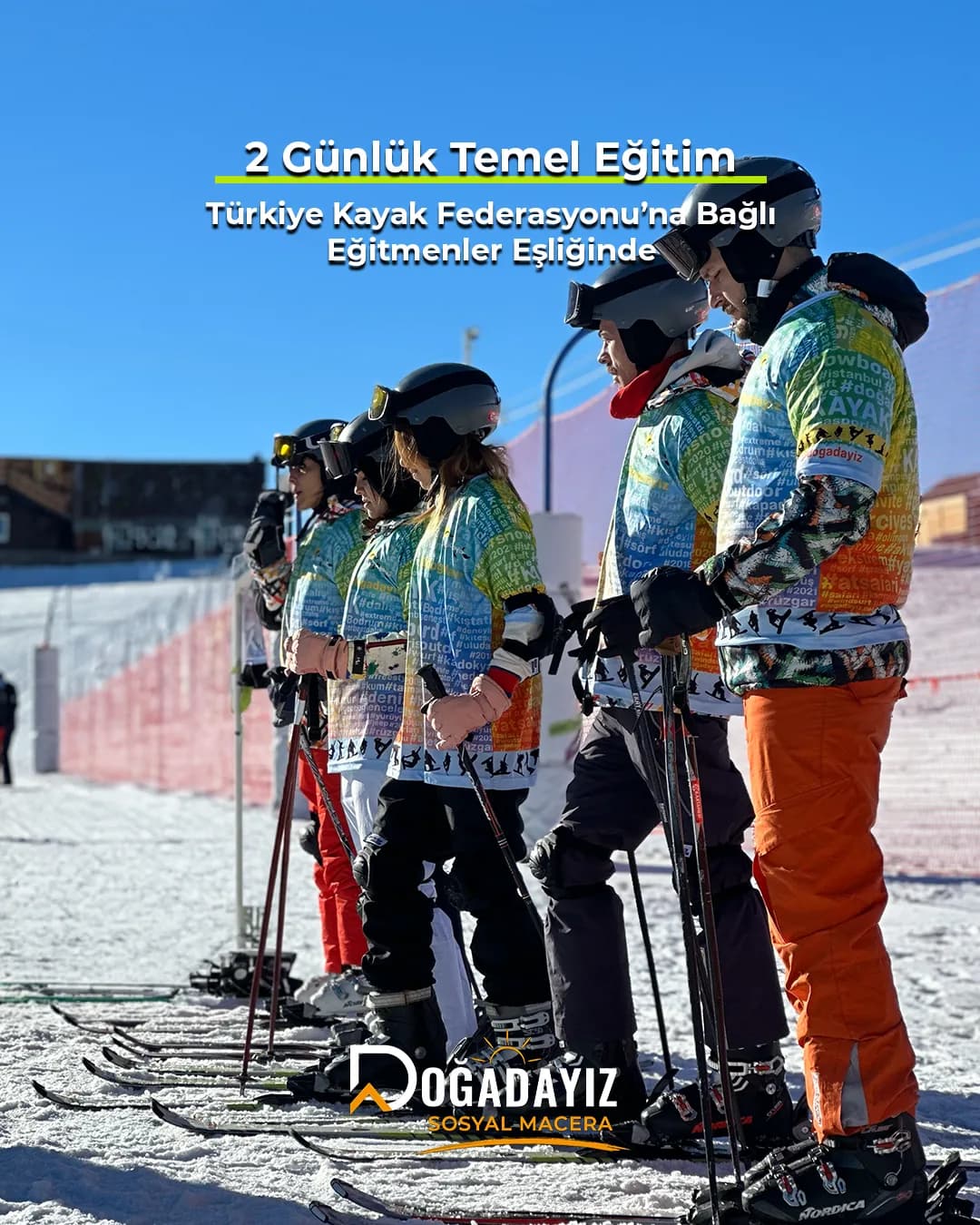
An activity holiday puts a sport at the heart of your trip: transport, accommodation and meals are planned, so you can focus on learning on the slopes. On Doğadayız winter activity holidays, accommodation, ski pass and ski or snowboard equipment are included in every package; course packages include basic lessons with instructors affiliated with the Turkish Ski Federation, while experience packages let you practise on the slopes at your own level.
What makes the programme different is the group: sharing the slopes with people at a similar level, dinners and nights out together, and a group leader by your side at all times. Solo travellers become part of this social adventure holiday from day one. That is why we describe our programmes as a social adventure holiday.
Snow guns spray water under pressure into very small droplets; the droplets freeze in the air and bond together on the ground to form snow. No additives are used, only water and air.
At what temperature can artificial snow be made?
What matters is the wet-bulb temperature (temperature and humidity together). According to the SLF, at a wet-bulb temperature between −2 and −4 °C snowmaking can only just begin; the colder and drier the air, the higher the output.
How much snow can be made from one cubic metre of water?
According to the SLF, in theory 2.5 cubic metres, and in practice at most about 2.2 cubic metres of snow. Some of the water is lost to wind and evaporation.
Is there artificial snow at Erciyes?
Yes. According to information from Erciyes A.Ş., the resort has 154 snow guns.
The snow on the slope is not the same every day. According to the definitions of MeteoSwiss, the Swiss meteorological office, powder is fresh snow that has not yet been compacted; hard snow is snow compacted by melting and refreezing or by wind, and its most extreme form is crust; corn (spring) snow is moist snow whose surface thaws in the daytime sun, typical in spring. Artificial snow (machine-made snow, the name scientists prefer), according to the WSL Institute for Snow and Avalanche Research (SLF), is much denser than natural snow (fresh natural snow averages ~100 kg/m³, dry machine-made snow ~400 kg/m³) and consists of small, round grains of 0.1–1 mm. That is why machine-made snow creates a more durable but harder slope.
Ski slopes are prepared with tracked grooming machines known in the industry as piste bashers (in Turkish, ratrak). According to the handbook of the Swiss Institute for Snow and Avalanche Research (SLF), the blade at the front moves the snow and levels the surface, the tiller at the back compacts the snow and breaks up its grains to create a smooth, durable surface, and the winch (cable) makes it possible to prepare steep slopes. According to the SLF, the best time to groom is shortly after the slopes close: in the morning, a slope groomed in the evening is more than twice as durable as one groomed in the early hours. The slopes are closed while grooming is under way; according to the German Alpine Club, there is danger to life especially when a winch is in use.
The easiest way to plan your first ski holiday is to get the order right: assess your level → choose the resort → allow at least 2–3 days on the slopes → pick dates with the mid-year school holiday crowds in mind → plan lessons, equipment, ski pass and accommodation together → get your clothing ready → check safety and insurance. For someone who has never skied, a resort with a large training area (e.g. Erciyes) and lessons with an instructor are essential. A winter activity holiday that brings all these pieces together in one package is the way to make the fewest mistakes on your first trip.