The key to teaching children to ski is play. France’s ski school ESF says that lessons at Club Piou-Piou, its club for ages 3–5, are taught through play, and that its children’s programmes are built on fun, freedom and play. The American instructors’ association PSIA-AASI uses the CAP model, which looks at the child together with their cognitive, affective and physical development: two children of the same age learn differently. In practice, this means short lessons with plenty of breaks, explained through stories and games. For safety, a helmet and a suitable beginner area are essential.
Young children cannot follow technical instructions the way adults do; their attention spans are short and they tire quickly in the cold. That is why ski schools build their children’s lessons on play. At Club Piou-Piou, ESF’s club for ages 3–5, instructors teach through play; the school’s children’s programme is built on fun, freedom and play and follows a progression that starts with Piou-Piou and continues through the Ourson, Flocon and star (Étoiles) levels.
Lessons matched to the child’s development: the CAP model
At the heart of PSIA-AASI’s children’s teaching manual is the CAP model:
Cognitive: How does the child think and perceive? Young children learn through comparisons and stories rather than abstract instructions.
Affective: How does the child react and socialise? Fear, embarrassment and excitement set the pace of the lesson.
Physical: How does the child grow and learn to move? Strength, balance and coordination change with age.
That is why two children of the same age can progress at different speeds. A study of 54 children aged 7–8 at a six-day ski school (Collegium Antropologicum, 2015) found that motor abilities such as coordination, movement frequency, strength and agility predicted technical success. In other words, movement games played away from the snow are also preparation for skiing.
10 games to play in the snow
Game
What does it teach?
Pizza and chips
Switching between the snowplough (pizza) and a parallel stance (chips)
Traffic lights
Stop on red, go on green: speed control and stopping
“We are following the rabbit through the forest”: linking small turns with a story
These games are based on comparisons and exercises widely used in ski schools; however, there is no controlled study comparing play-based ski teaching with other methods. The real goal is for the child to enjoy it and want to come back.
Tips for families
Choose a children’s ski school: Teaching your own child can strain the relationship; at school, children learn more easily alongside their peers and with an experienced instructor.
Keep it short: A morning lesson, a lunch break and a short afternoon are enough. Stop at signs of cold or tiredness.
Celebrate success: The first stop, the first turn, the first ride down from the magic carpet. Small rewards and badges boost motivation.
A helmet is essential: Research shows that helmets reduce head, neck and face injuries in children under 13; in Erciyes, wearing a helmet is compulsory for everyone.
Play is not just for children. In adult lessons too, comparisons, small goals and fun in the group make learning easier; the most effective thing for reducing fear is often a good laugh. Doğadayız winter programmes are for participants aged 12 and over and are designed as an activity holiday: lessons, equipment, ski pass and accommodation in one package, while the evenings spent with the group are part of a social adventure holiday. For the programmes, see the winter activity holidays page.
Doğadayız Packages
Doğadayız packages for your level
Winter activity holidays with accommodation, ski pass and equipment included, shared with a group.
The easiest way to learn to ski: a winter activity holiday
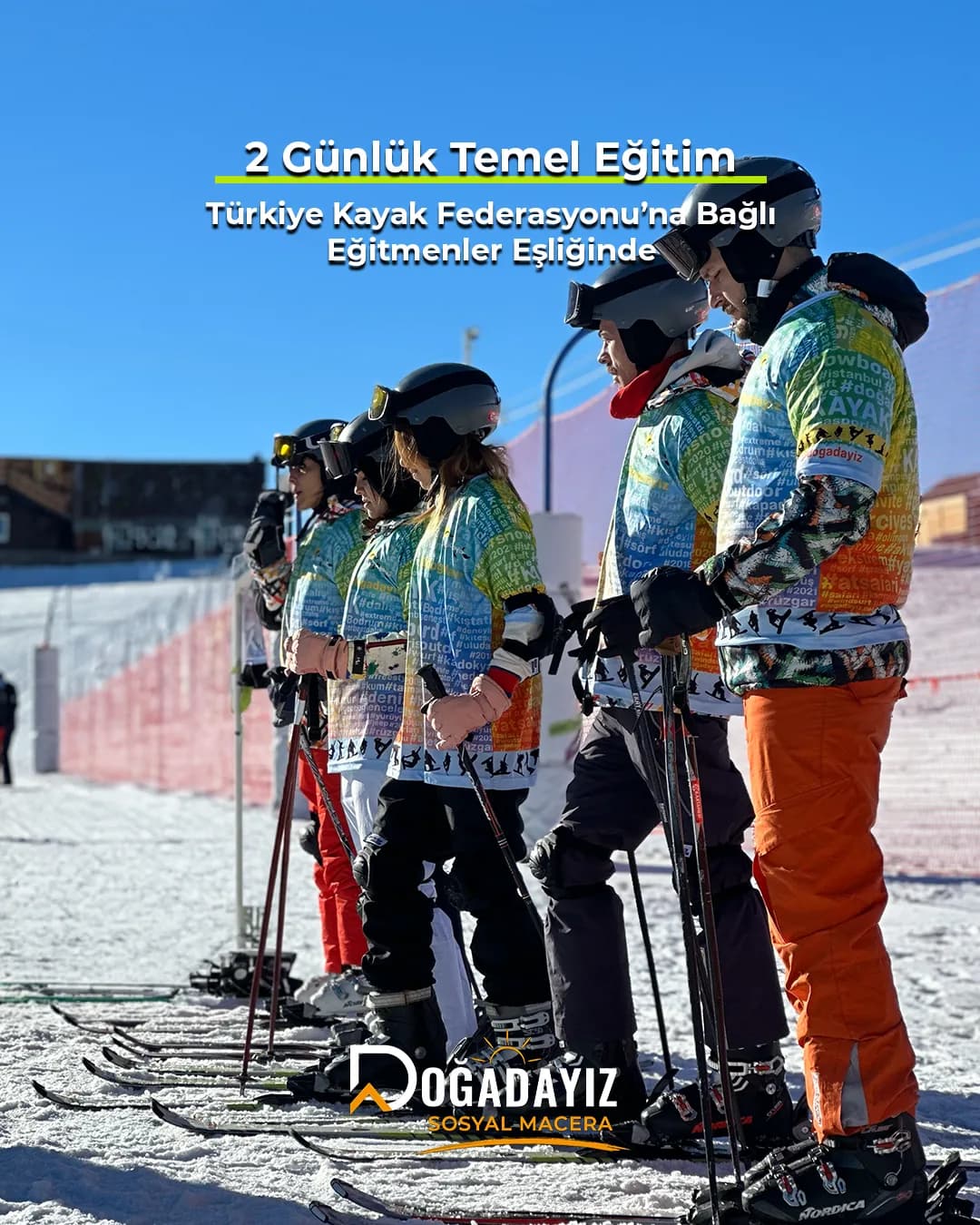
An activity holiday puts a sport at the heart of your trip: transport, accommodation and meals are planned, so you can focus on learning on the slopes. On Doğadayız winter activity holidays, accommodation, ski pass and ski or snowboard equipment are included in every package; course packages include basic lessons with instructors affiliated with the Turkish Ski Federation, while experience packages let you practise on the slopes at your own level.
What makes the programme different is the group: sharing the slopes with people at a similar level, dinners and nights out together, and a group leader by your side at all times. Solo travellers become part of this social adventure holiday from day one. That is why we describe our programmes as a social adventure holiday.
Through play. Ski schools give young children short lessons with plenty of breaks, using stories and games; for example, the snowplough is explained as “pizza” and the parallel stance as “chips”. The most important goal is for the child to enjoy it and want to come back.
What is the CAP model?
It is the model that the American instructors’ association PSIA-AASI uses as the basis for teaching children: it looks at the child together with their cognitive (how they think), affective (how they react and socialise) and physical (how they grow and move) development.
Can I teach my child to ski myself?
It is possible, but usually not recommended. Learning at a children’s ski school with peers and an experienced instructor is more relaxed for both the child and the family; meanwhile, the family can ski at their own level.
Children can usually start learning to ski at age 3–4, and snowboarding from age 4. France’s ski school ESF offers a play-based club for ages 3–5, and schools in Switzerland run group lessons from age 3; according to Burton, snowboard schools usually start at age 4. The operator’s children’s school in Bansko is for ages 4–7. At these ages, lessons progress through play and in short sessions. For safety, a helmet is essential: research shows that helmets reduce head, neck and face injuries in children under 13. In Erciyes, children cannot ride the lifts without an adult.
Being afraid while learning to ski is perfectly normal, and it directly affects learning: in a study of 337 students, beginners did better the lower their fear and the higher their self-efficacy (the belief that “I can do it”); self-efficacy predicted success. The way to manage fear is not to suppress it but to build confidence through small, successful steps: a gentle area, the right falling technique, an instructor who gives you choices and a group at the same level. In one study, teaching that gave learners choices (autonomy-supportive teaching) improved skill and self-confidence more without needing extra time.
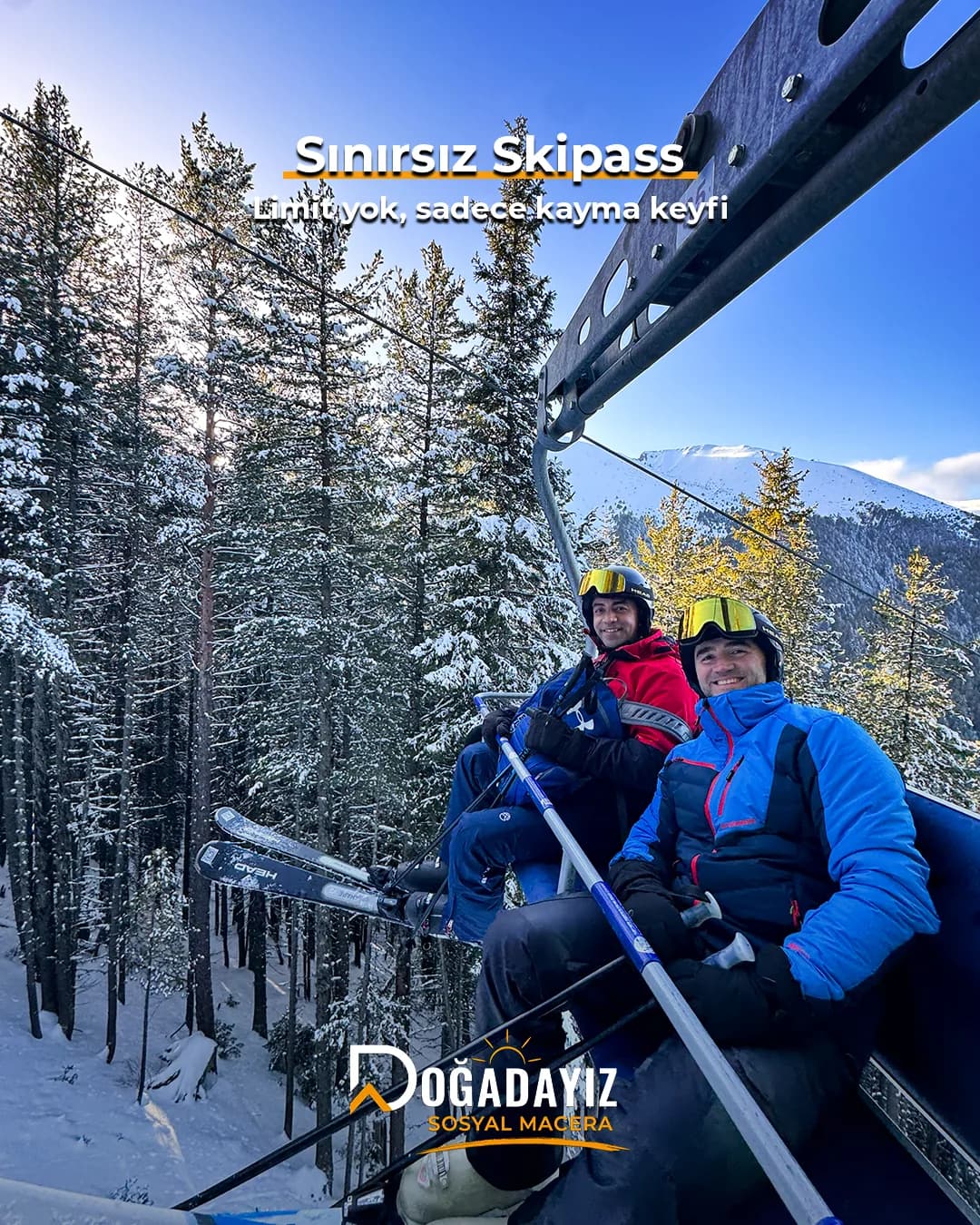
Ski resorts have four types of lift: the magic carpet, the drag lift (T-bar), the chairlift and the gondola. Beginners master the magic carpet first, then the chairlift; the drag lift is the hardest because it takes balance. The basic rule on a chairlift: watch the chair over your shoulder, sit all the way back, lower the safety bar once everyone is seated, raise it as you approach the top and move away from the ramp straight away. On a snowboard, you ride the lifts with your back foot out of the binding. Under the Erciyes rules, children may not ride the lifts without an adult.