How Do You Manage Fear and Motivation When Learning to Ski?
Being afraid while learning to ski is perfectly normal, and it directly affects learning: in a study of 337 students, beginners did better the lower their fear and the higher their self-efficacy (the belief that “I can do it”); self-efficacy predicted success. The way to manage fear is not to suppress it but to build confidence through small, successful steps: a gentle area, the right falling technique, an instructor who gives you choices and a group at the same level. In one study, teaching that gave learners choices (autonomy-supportive teaching) improved skill and self-confidence more without needing extra time.
A frightened skier tenses up, leans back and tries to get away from the slope; this makes control harder and increases the chance of falling. Research also shows this relationship in numbers: in a study of 337 students who had never skied before or were at beginner level (Sports, 2018), beginners’ skiing skills were better the lower their fear and the higher their self-efficacy, meaning the belief that “I can do this”; self-efficacy predicted success. In the same study, women had higher fear scores.
Types of fear
Fear
What does it look like?
First step
Fear of falling
Tensing up, leaning back
Learning the right way to fall and get up
Fear of speed
Running away from the slope, sudden stops
Getting speed control solid with the snowplough
Fear of lifts
Panic when getting off the chairlift
First the magic carpet, then the chairlift with an instructor
Falling in front of others
Embarrassment, not trying
Learning with a group at the same level
8 ways to manage fear
Learn to fall. Most fear comes from falling. In the first lesson you are taught the right way to fall and get up; seeing that a fall can be harmless quickly reduces fear.
Start on a gentle area. A wide beginner area served by a magic carpet lets you enjoy your first successes safely.
Speed control first. Knowing that you can slow down and stop whenever you want with the snowplough takes the fear out of the slope.
Set small goals. Instead of “I’m going to ski this run”, try “I’m going to make three controlled turns”. Every small success boosts self-efficacy.
Have a say. In a controlled trial (Frontiers in Psychology, 2026), teaching that gave learners choices, explained and supported them improved skill, self-efficacy and mental toughness more than traditional teaching, and it needed no extra lesson time. A good instructor asks you which exercise you want to repeat.
Focus your attention outwards. The OPTIMAL theory of motor learning suggests that factors such as positive expectations, learner autonomy and an external focus (looking at where you are going, not at your feet) support learning.
Don’t push it when you’re tired. At the end of the day technique falls apart and fear grows; do your last run on an easy slope.
Draw strength from the group. Seeing someone at the same level fall and get up too gives you the feeling that “it’s not just me”.
The instructor’s role
The children’s teaching model of the American instructors’ association PSIA-AASI looks at learning together with its cognitive, physical and affective (emotions and social relationships) dimensions; the same approach applies to adults. A good instructor sees not only the technique but also the learner’s anxiety: they adjust the pace, point out successes and say that fear is normal. We explain how to choose an instructor in our guide How to choose a good ski or snowboard instructor.
Keeping motivation up: day two
The hardest moment in learning to ski is often the second morning: your legs are tired (muscle soreness) and the falls of the first day are on your mind. Three things help at this point: remembering the previous day’s successes, spending the first hour warming up in an easy area and starting together with the group. On Doğadayız basic course packages, tuition time is not limited by the hour; on the afternoon of the first day, groups are re-formed by level, so nobody feels left behind or overstretched.
Sharing the fear: a social adventure holiday
Fear shrinks when it is shared. On an activity holiday, starting in the same beginner area with people at the same level, laughing about your falls over lunch and going over the day together in the evening is the easiest way to learn to ski. That is also why Doğadayız winter programmes are designed as a social adventure holiday; for those who have never skied, there are Erciyes basic course packages.
Doğadayız Packages
Doğadayız packages for your level
Winter activity holidays with accommodation, ski pass and equipment included, shared with a group.
The easiest way to learn to ski: a winter activity holiday
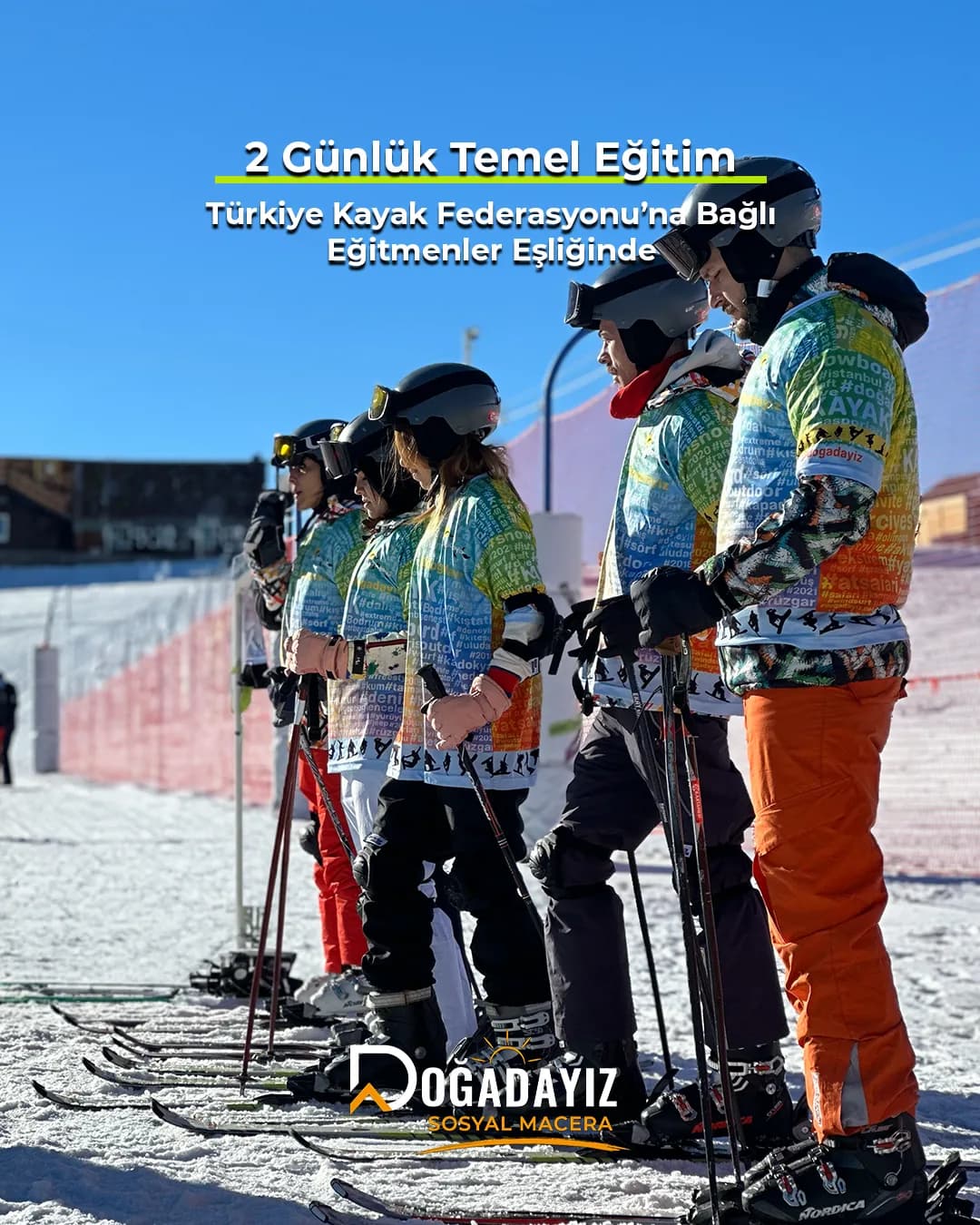
An activity holiday puts a sport at the heart of your trip: transport, accommodation and meals are planned, so you can focus on learning on the slopes. On Doğadayız winter activity holidays, accommodation, ski pass and ski or snowboard equipment are included in every package; course packages include basic lessons with instructors affiliated with the Turkish Ski Federation, while experience packages let you practise on the slopes at your own level.
What makes the programme different is the group: sharing the slopes with people at a similar level, dinners and nights out together, and a group leader by your side at all times. Solo travellers become part of this social adventure holiday from day one. That is why we describe our programmes as a social adventure holiday.
Yes, it is very common. Research shows that beginners’ skiing skills are better the lower their fear and the stronger their belief that “I can do it”. Managing fear with small, successful steps speeds up learning.
How do you overcome the fear of falling when skiing?
First learn the right way to fall and get up, start on a gentle beginner area and see for yourself that you can stop whenever you want with the snowplough. Experiencing that a fall can be harmless quickly reduces fear.
I’m afraid of speed. Can I still learn to ski?
Yes. The cure for a fear of speed is speed control: do not go onto a slope until slowing down and stopping with the snowplough is solid. Progressing on easy slopes with short, controlled turns builds confidence.
No, adults do not find it hard to learn to ski; they just learn differently. According to Doğadayız booking records, the average age of the 2,140 people who joined the basic course packages over the last four winter seasons is 31.6; 56% are over 30 and 14% over 40. Adults are more cautious than children and more wary of falling, so it is important to start in the right order, with an instructor and in a gently sloping beginner area. Physical preparation, rental equipment that is set up correctly and a two- or three-day winter activity holiday are the most effective start for an adult.
For someone who has never skied, group lessons are often enough and cheaper; the topics of the first days (balance, snowplough, stopping, first turns) are the same for everyone, and learning with people at the same level boosts motivation. Private lessons suit those who want to solve a specific problem, overcome fear or progress quickly in a short time. The price difference is large: at Snow Academia in Erciyes in the 2025–26 season, a one-to-one lesson cost 4,000 TL per hour, while in groups of 5 or more it was 2,250 TL per person. Group lessons also kick off the social side of a winter activity holiday.
Research shows that outdoor sports such as skiing are positively associated with mental health, but most of it is observational and does not prove causation. In a Swedish study that followed more than 395,000 people for up to 21 years, participants in a long-distance cross-country ski race had roughly half the risk of depression and a markedly lower risk of anxiety. A study of 19,806 people in England found that spending at least 120 minutes a week in nature is associated with better health and wellbeing. According to the World Health Organization, physical activity reduces symptoms of depression and anxiety. A winter social adventure holiday brings these three together: movement, nature and social ties.