How Do You Choose Your First Snowboard? Length, Weight, Width and Riding Style
When choosing your first snowboard, weight matters more than height: according to Burton, the board only “knows” your weight and your boot size, and manufacturers' weight ranges are recommendations, not rules. A practical starting point is a length that comes between your chin and nose when the board is stood upright; for beginners, Ride finds a slightly shorter board more forgiving. If your boot size is large (men's US 11–12 and above), you may need a wide board; otherwise your toes and heels drag in the snow. For a beginner, soft flex and a forgiving profile (according to Burton, a soft flat profile) make the easiest start. Renting in your first season is the best choice.
The classic rule for snowboard length is that the board should come between your chin and nose when stood upright; manufacturers such as K2 and Ride still use this practical rule. But Burton's buying guide gives an important warning: the board does not “know” your height, only your weight and your boot size. The weight ranges manufacturers give are recommendations, not rules; if you are at the top end of the range the board will feel softer, and if you are at the bottom end it will feel stiffer.
Examples from K2's table by height and weight:
Your height
Under 59 kg
59–82 kg
Over 82 kg
163 cm
144–150 cm
148–154 cm
152–158 cm
173 cm
150–156 cm
154–160 cm
158–164 cm
183 cm
156–162 cm
160–166 cm
164–170 cm
According to K2, you choose a board 2–4 cm shorter for the park and 2–4 cm longer for powder. For beginners, Ride says that a slightly shorter board is more forgiving and easier to control.
Width: boot overhang
The waist width of the board should suit your boot size. According to K2, your boots should overhang the edges of the board by about 1–2 cm on each side. If they overhang more, your toes or heels drag in the snow during turns (toe/heel drag); if they do not overhang at all, the board feels sluggish and is hard to turn.
Burton's recommendation:
Boot size (US)
Do you need a wide board?
Men's under 9 / women's under 10
Most likely not
Men's 11–12 / women's 13–14
Possibly, depending on personal preference
Men's over 12
Almost certainly yes
Flex: start soft
Flex is how flexible the board is. According to Burton, boards aimed at beginners have a simple shape, a soft flex and a profile that reduces catching an edge; Ride and K2 also say that a soft flex makes manoeuvring easier and is ideal for beginners. Burton also points out that flex ratings are defined differently from brand to brand.
Profile: flat, camber, rocker
The board's profile, seen from the side, determines how it feels (see the camber–rocker entry in the glossary):
Profile
According to Burton
Flat
Flat boards with a soft flex are very good for beginners and intermediates
Camber
Generally good for all levels; strong edge hold
Rocker
Good for intermediate all-mountain riding; less precise control on hard pistes
Ride and K2, on the other hand, say that beginners progress well on rocker profiles. Burton's conclusion is important: there is no single “right” profile. For a beginner, a soft flex and the right length matter more than the profile. Catching an edge causes the hardest falls of the first days; a forgiving board reduces this risk.
Style: start with all-mountain
The best choice for your first board is an all-mountain board that works in all conditions. Specialist boards for the park (freestyle) or powder come later.
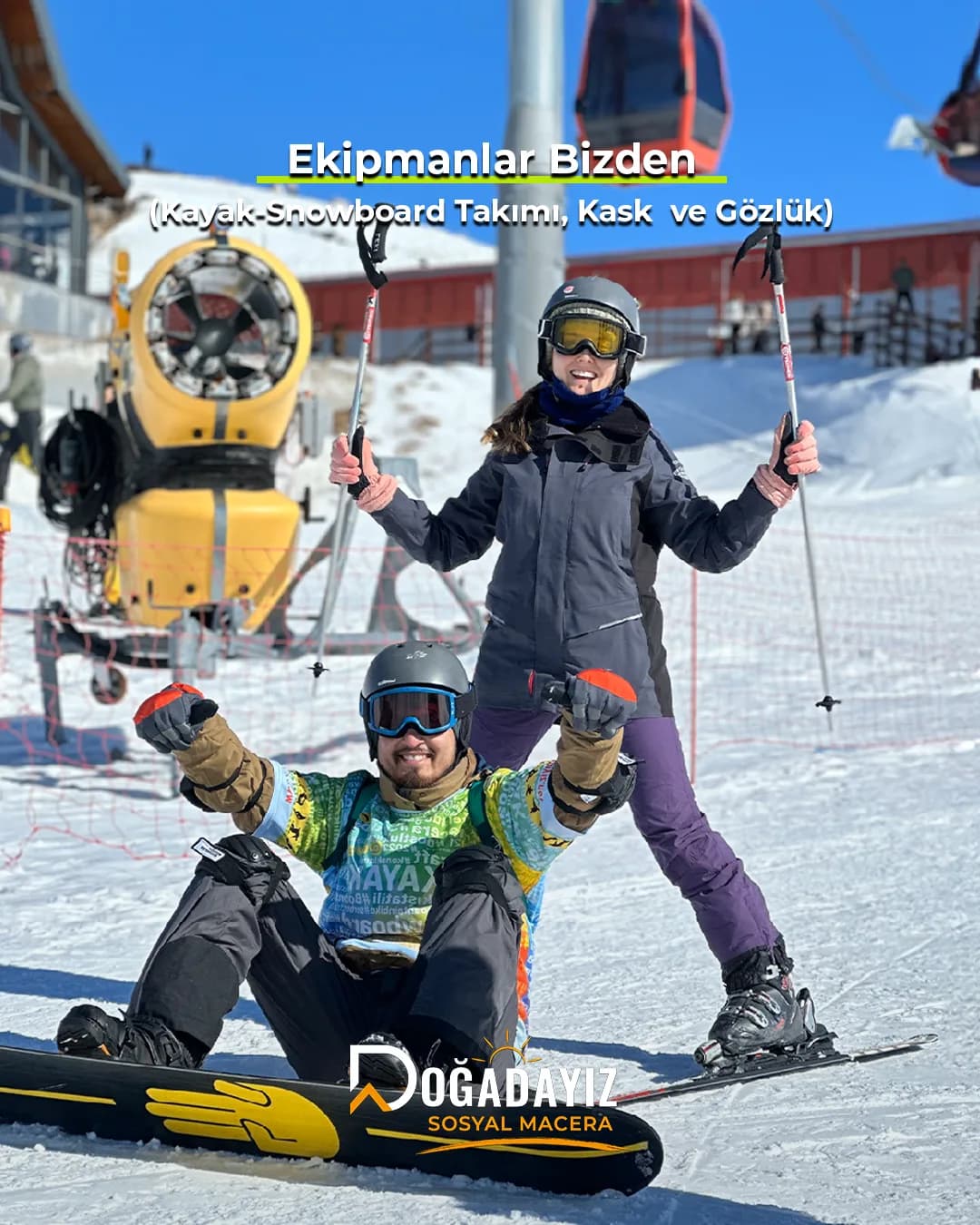
Burton's advice to beginners is clear: while you are learning, choose lessons over new equipment, rent your snowboard set and invest in equipment once you have learned the basics. On an activity holiday, equipment is already included in the package: a snowboard set (board, boots, bindings) is part of every Doğadayız winter package; the Erciyes basic course packages also include protective gear such as a helmet, goggles and wrist guards. Learning with people at the same level turns the programme into a social adventure holiday; for programmes, see our winter activity holidays page.
Doğadayız Packages
Doğadayız packages for your level
Winter activity holidays with accommodation, ski pass and equipment included, shared with a group.
The easiest way to learn to ski: a winter activity holiday
An activity holiday puts a sport at the heart of your trip: transport, accommodation and meals are planned, so you can focus on learning on the slopes. On Doğadayız winter activity holidays, accommodation, ski pass and ski or snowboard equipment are included in every package; course packages include basic lessons with instructors affiliated with the Turkish Ski Federation, while experience packages let you practise on the slopes at your own level.
What makes the programme different is the group: sharing the slopes with people at a similar level, dinners and nights out together, and a group leader by your side at all times. Solo travellers become part of this social adventure holiday from day one. That is why we describe our programmes as a social adventure holiday.
A practical starting point is a length that comes between your chin and nose when the board is stood upright. But weight matters more than height; check the manufacturers' weight ranges. For beginners, a slightly shorter board is more forgiving.
Do I need a wide snowboard?
It depends on your boot size. According to Burton, with men's boots smaller than US 9 you most likely do not need one; at US 11–12 it is a matter of preference; with boots larger than US 12 you almost certainly need a wide board. Your boots should overhang the edges of the board by about 1–2 cm on each side.
Camber or rocker for a beginner?
There is no single right answer. Burton recommends flat profiles with a soft flex for beginners; Ride and K2 say that rocker profiles suit beginners. For a beginner, a soft flex and the right length matter more than the profile.
Should I buy a snowboard in my first season?
Usually not. Burton recommends choosing lessons over new equipment while you are learning and renting your snowboard set; it makes more sense to invest in equipment once you have learned the basics.
Snowboard boots should fit snugly but without hurting, and your heel should not lift. According to Burton, do not assume your everyday shoe size; wear the boots and walk around for 5–10 minutes. When you bend your knees, your toes should lightly touch the end of the liner, and if your heel lifts with the boots fully laced, try half a size smaller. For beginners, a soft and forgiving flex is best. There are three lacing options: traditional laces (full control), BOA (even tightening with a dial, adjustable with gloves on) and two-zone speed lacing. In your first season you can rent boots too; what matters is the right size and fit.
On a snowboard, if your left foot is in front you ride regular, and if your right foot is in front you ride goofy. Both are correct; as Burton puts it, “regular doesn't mean right and goofy doesn't mean wrong”. There are three simple tests to find out which one you are: the foot you put forward when sliding on a slippery floor in your socks, and the foot you step forward with to keep your balance when someone gives you a gentle push from behind, is usually your front foot; the foot you start climbing stairs with, on the other hand, is most likely your back foot. For beginners, Burton recommends a binding set-up with the front foot positive and the back foot at zero (+/0).
You start snowboarding by finding your stance (regular or goofy), with a beginner lesson with an instructor and with rental equipment. On day one you learn to push with one foot and to side-slip on your heel edge (heelside) and your toe edge (toeside); then you change direction with the falling leaf, and usually on day 2–3 you make your first linked turns.