Regular or Goofy? Finding Your Front Foot on a Snowboard
On a snowboard, if your left foot is in front you ride regular, and if your right foot is in front you ride goofy. Both are correct; as Burton puts it, “regular doesn't mean right and goofy doesn't mean wrong”. There are three simple tests to find out which one you are: the foot you put forward when sliding on a slippery floor in your socks, and the foot you step forward with to keep your balance when someone gives you a gentle push from behind, is usually your front foot; the foot you start climbing stairs with, on the other hand, is most likely your back foot. For beginners, Burton recommends a binding set-up with the front foot positive and the back foot at zero (+/0).
Asking which one is “right” is the wrong question: what matters is finding what feels natural to you. Starting with the wrong stance slows your progress noticeably; that is why your stance is determined on day one. There is no reliable data on the share of goofy and regular riders; Burton also notes that no comprehensive data exists.
3 tests to find your stance
Sock slide: Take a run-up and slide across a slippery floor in your socks. The foot you put forward is most likely your front foot.
Push test: Have someone give you a gentle push from behind (in a safe setting). The foot you step forward with so you don't fall is most likely your front foot.
Stairs test: The foot you start climbing stairs with is most likely your back foot.
Don't worry if the tests give different results: try both stances on your first runs; after a few attempts it becomes clear which one feels more natural. Instructors usually do these tests in the first lesson.
Stance width
According to Burton, your stance should be slightly wider than shoulder width. Too narrow a stance makes balancing harder; too wide a stance stops your knees from bending comfortably.
Binding angles
The binding angle is how far the bindings are rotated relative to the axis of the board:
Set-up
How?
Who is it for?
Positive / zero (+/0)
Front foot turned forward, back foot straight
According to Burton, the recommended set-up for beginners
Duck (+/−)
Front foot turned forward, back foot turned backwards
Mostly for freestyle riders and those who ride in the opposite direction (switch)
Positive / positive (+/+)
Both feet turned forward
According to Burton, for experienced riders
Tell the rental shop your stance (regular or goofy); the bindings are set up accordingly.
Front foot and weight
Once your stance is set, the most important rule is this: when riding, most of your weight should be on your front foot. The most common beginner mistake is shifting weight onto the back foot out of fear; this makes you lose control of the board. See the front and back foot entry in the glossary.
Next step
Once your stance and binding angles are set, it is time for your first slides: gliding with one foot strapped in, then the heel edge (heelside) and the toe edge. For the full roadmap, see our guide How to Start Snowboarding.
Day one on an activity holiday
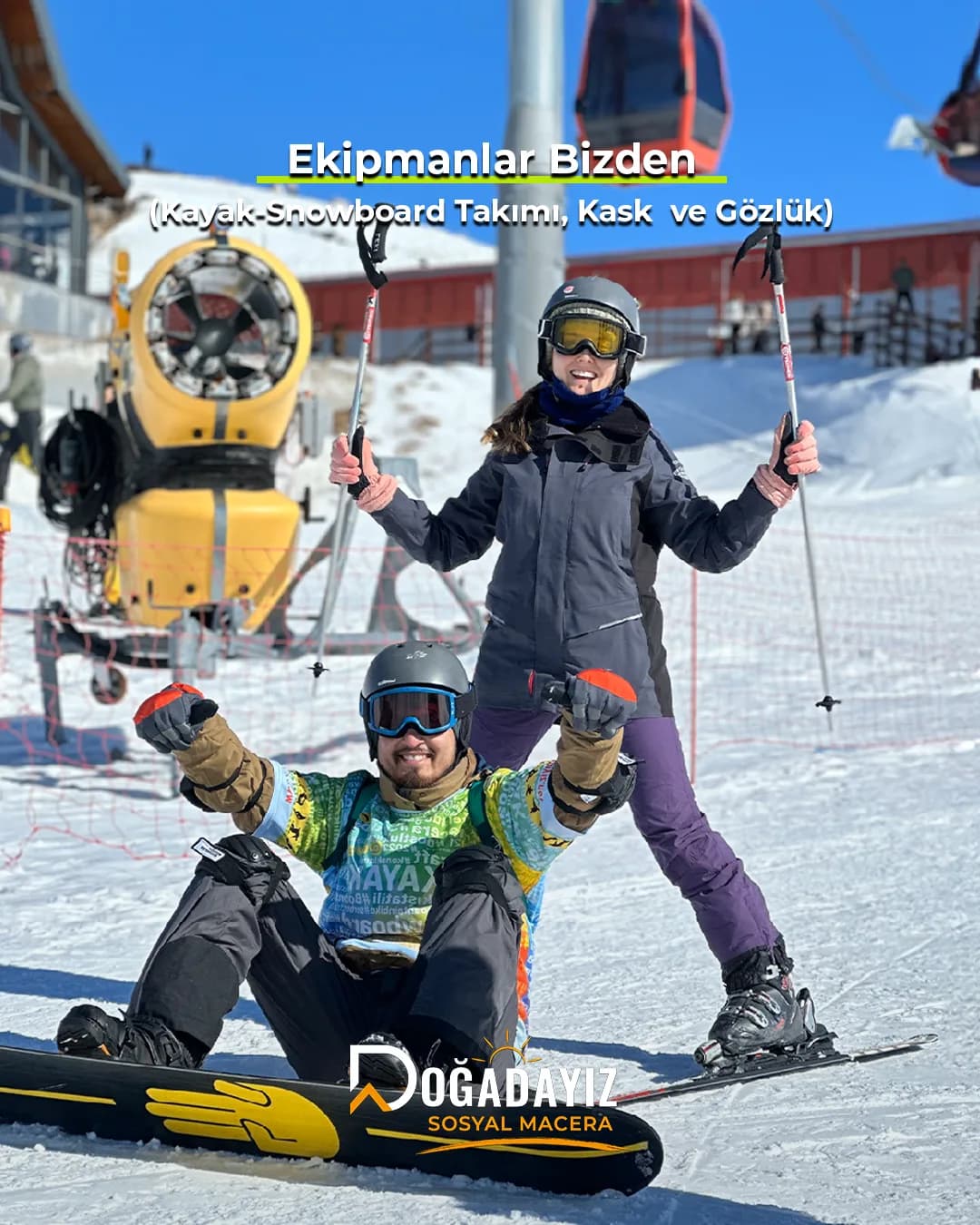
Finding your stance, setting up your bindings and your first slides go much faster with an instructor. On an activity holiday, these first hours are planned: on Doğadayız Erciyes basic course packages, instructors affiliated with the Turkish Ski Federation (TKF) determine your stance on day one, and the snowboard set and protective gear are included. Learning with people at the same level turns the programme into a social adventure holiday; for programmes, see our winter activity holidays page.
Doğadayız Packages
Doğadayız packages for your level
Winter activity holidays with accommodation, ski pass and equipment included, shared with a group.
The easiest way to learn to ski: a winter activity holiday
An activity holiday puts a sport at the heart of your trip: transport, accommodation and meals are planned, so you can focus on learning on the slopes. On Doğadayız winter activity holidays, accommodation, ski pass and ski or snowboard equipment are included in every package; course packages include basic lessons with instructors affiliated with the Turkish Ski Federation, while experience packages let you practise on the slopes at your own level.
What makes the programme different is the group: sharing the slopes with people at a similar level, dinners and nights out together, and a group leader by your side at all times. Solo travellers become part of this social adventure holiday from day one. That is why we describe our programmes as a social adventure holiday.
On a snowboard, left foot forward is a regular stance and right foot forward is goofy. Both are correct; what matters is finding what feels natural to you.
How do I know if I am regular or goofy?
The foot you put forward when sliding on a slippery floor in your socks and the foot you step forward with when someone gives you a gentle push from behind is usually your front foot. The foot you start climbing stairs with, on the other hand, is most likely your back foot.
What snowboard binding angles should a beginner use?
For beginners, Burton recommends a set-up with the front foot turned forward (positive) and the back foot straight (zero). A duck set-up is mostly for freestyle riders and those who ride in the opposite direction.
You start snowboarding by finding your stance (regular or goofy), with a beginner lesson with an instructor and with rental equipment. On day one you learn to push with one foot and to side-slip on your heel edge (heelside) and your toe edge (toeside); then you change direction with the falling leaf, and usually on day 2–3 you make your first linked turns.
When choosing your first snowboard, weight matters more than height: according to Burton, the board only “knows” your weight and your boot size, and manufacturers' weight ranges are recommendations, not rules. A practical starting point is a length that comes between your chin and nose when the board is stood upright; for beginners, Ride finds a slightly shorter board more forgiving. If your boot size is large (men's US 11–12 and above), you may need a wide board; otherwise your toes and heels drag in the snow. For a beginner, soft flex and a forgiving profile (according to Burton, a soft flat profile) make the easiest start. Renting in your first season is the best choice.
Heelside is the long edge of the snowboard under your heels. On the heel edge you stand facing down the slope and press this edge into the snow by pushing through your heels: increase the pressure and you slow down and stop, ease it off and you slide. Most beginners learn speed control and stopping on a snowboard on the heelside first.