How Do You Choose Ski Boots? Size (Mondopoint), Flex and Last Width
When choosing ski boots, you look at four things: size, flex (stiffness), last width and fit. Ski boot sizes are given in the Mondopoint system: your foot length in centimetres (e.g. 26.5). For beginners, a soft to medium flex is recommended; Nordica gives this range as 40–80, while Atomic puts it at the lower end of a scale starting at around 70, but there is no common measuring standard for flex across brands. The most common mistake is buying boots that are too big: according to Atomic's shell test, 2 cm of space behind the heel in the boot with the liner removed is right for most skiers, and 3 cm is too big.
Ski boots are measured with the Mondopoint (ISO 9407) system instead of shoe sizes. According to Atomic, Mondopoint is the length of your foot in centimetres and goes up in 5-millimetre steps (26, 26.5, 27…). According to Fischer, the system is used to standardise sizes across brands. One boot shell often covers two sizes (e.g. 27/27.5); the difference is made up by the insole and liner.
To measure your foot: Stand with your heel against a wall and measure the distance to the tip of your longest toe in centimetres. If your feet are different sizes, go by the longer one.
Flex: the stiffness of the boot
Flex is how much the boot resists bending forward. A soft to medium boot suits beginners: a soft boot is more comfortable and forgiving, while a stiff boot transmits your movements to the ski more directly.
Source
For beginners
Nordica
40–80 (beginner to intermediate), 80–120 intermediate to advanced, 120–150 racers and experts
Atomic
The lower end of a scale running from about 70 to 170; for lighter or beginner skiers
Two important notes: according to Atomic, there is no standard method of measuring the flex index, so an 80 from one brand may not be the same as an 80 from another. Nordica also points out that boots get stiffer in the cold; a boot that feels soft in the shop may be stiffer on the slopes.
Last width
Last width is the inside width of the boot in the forefoot area, given in millimetres. According to Atomic's classification:
Last
Width
Narrow
Under 98 mm
Medium
About 100 mm
Wide
102 mm and above
According to Nordica, the width is usually given for size 26.5 and changes slightly with each shell size. Someone with wide feet will get numbness and pain in a narrow last; someone with narrow feet will feel their foot sliding around inside a wide last.
Fit: the shell test and trying on
Shell test (Atomic): Take out the liner, put your foot in the shell wearing a thin sock, slide your toes forward and look at the space behind your heel:
Space
What it means
About 1 cm
Tight, performance-oriented fit
About 2 cm
An average fit most skiers will be happy with
About 3 cm
Too big; cannot be corrected
Atomic says the most common mistake skiers make is buying boots that are bigger than necessary; according to Nordica, up to 60% of skiers use boots that are too big. A big boot may seem comfortable, but your foot slides around inside, you lose control and your foot gets cold.
Trying on (Fischer): Try boots on with ski socks, ideally later in the day (when your feet have swollen a little). Bend your knees into a skiing stance: your toes may lightly touch the front, but your midfoot and heel should be held firmly and your heel should not lift. Wear a single pair of thin ski socks inside the boot; thick socks do not keep your feet warmer, they actually spoil the fit.
What to check with rental boots
You can rent boots in your first season too. At the rental shop:
Tell them your Mondopoint size, but still try two sizes.
Fasten the boot fully and bend your knees: if your heel lifts or your foot slides forward, try the smaller size.
If there is a clear pressure point, say so; first-day pain usually does not go away, it gets worse.
The binding is adjusted to the sole length of the boot; if you change boots, the binding must be readjusted.
Boots and your activity holiday
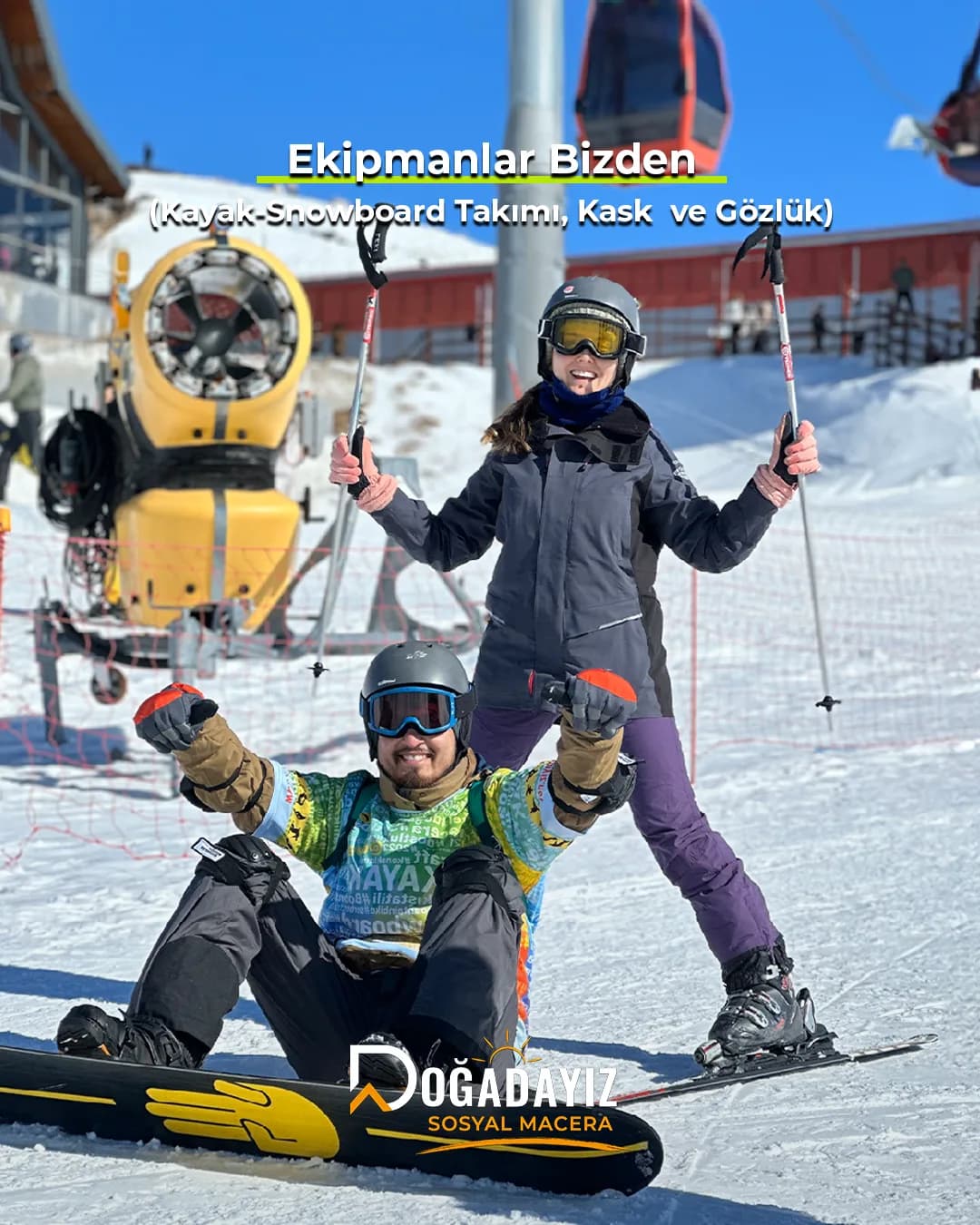
On an activity holiday, boots are part of the equipment: on Doğadayız winter packages, a ski or snowboard set is included in every package and handed out at the rental shop according to your size. Having your instructor check your boot fit on the first day is important for a pain-free first day. Learning with people at the same level turns the programme into a social adventure holiday. For choosing your first skis, see How do you choose your first skis?, and for deciding whether to rent, see Rent or Buy Skis and Snowboards?.
Doğadayız Packages
Doğadayız packages for your level
Winter activity holidays with accommodation, ski pass and equipment included, shared with a group.
The easiest way to learn to ski: a winter activity holiday
An activity holiday puts a sport at the heart of your trip: transport, accommodation and meals are planned, so you can focus on learning on the slopes. On Doğadayız winter activity holidays, accommodation, ski pass and ski or snowboard equipment are included in every package; course packages include basic lessons with instructors affiliated with the Turkish Ski Federation, while experience packages let you practise on the slopes at your own level.
What makes the programme different is the group: sharing the slopes with people at a similar level, dinners and nights out together, and a group leader by your side at all times. Solo travellers become part of this social adventure holiday from day one. That is why we describe our programmes as a social adventure holiday.
Ski boots are measured with the Mondopoint system: your foot length in centimetres. Stand with your heel against a wall and measure to your longest toe; if it is 26.5 cm, for example, your Mondopoint size is 26.5.
What flex should a beginner's ski boot have?
A soft to medium flex suits beginners. Nordica gives a range of 40–80 for beginner to intermediate level. However, there is no common measuring standard for flex across brands; the same number can mean a different stiffness from different brands.
How can I tell if my ski boots are too big?
Do the shell test: take out the liner, put your foot in the shell and slide your toes forward. According to Atomic, about 2 cm of space behind the heel is right for most skiers; 3 cm is too big.
Should I wear thick socks in ski boots?
No. Wear a single pair of thin, long ski socks. Thick or double socks do not keep your feet warm; they restrict circulation, make your feet cold and spoil the fit of the boot.
For a beginner, skis should be short and easy to turn. Manufacturers' rules differ slightly: Atomic recommends a length at about chin height for beginners; Salomon says to choose skis 10–15 cm shorter than your height, and 15 cm shorter for complete beginners; Head points to between the chin and the nose. If you are light and inexperienced, choose the shorter end; if you are heavy or sporty, the longer end. A short turn radius (about 12–15 m) and a little rocker make turning easier. In your first season, renting rather than buying is the easiest way to try out the right length.
For a beginner, the right approach is to rent in your first season. According to Burton, while you are learning you should prioritise lessons over new equipment, rent your gear and invest once you have learned the basics. When you decide to buy, the usual order is: first personal items (helmet, goggles, gloves, socks), then boots that fit your feet perfectly, and skis or a snowboard last. The main risk with rental equipment is a poor setting: for short-term rentals, the binding should be set by a technician according to ISO 13993. On a winter activity holiday package, equipment is usually already included.
For skiing and snowboarding you wear three layers: a synthetic or wool base layer that wicks sweat away, a fleece mid-layer that holds in warmth, and a ski jacket and trousers that keep out wind and water. Add a single pair of thin ski socks, waterproof gloves, a neck gaiter, a helmet and goggles. Do not wear cotton: it gets soaked with sweat and makes you cold.