How Do You Choose Your First Skis? Height, Weight, Level and Intended Use
For a beginner, skis should be short and easy to turn. Manufacturers' rules differ slightly: Atomic recommends a length at about chin height for beginners; Salomon says to choose skis 10–15 cm shorter than your height, and 15 cm shorter for complete beginners; Head points to between the chin and the nose. If you are light and inexperienced, choose the shorter end; if you are heavy or sporty, the longer end. A short turn radius (about 12–15 m) and a little rocker make turning easier. In your first season, renting rather than buying is the easiest way to try out the right length.
This table summarises manufacturers' recommendations; it is not a hard rule. Manufacturers differ: Atomic recommends about chin height for beginners and between the chin and forehead for advanced skiers, and on its product pages tells inexperienced and light skiers to subtract 5–10 cm from the top-of-the-head measurement; Salomon recommends skis 5–15 cm shorter than your height (15 cm for beginners); and Head points to between the chin and the nose.
More important than height: weight and level
Ski length is not determined by your height alone:
Weight: According to Atomic, light and inexperienced skiers should choose the shorter end, heavy or aggressive skiers the longer end. Salomon recommends sturdier skis if you are heavy for your height.
Level: Short skis turn more easily and make speed control more comfortable; long skis stay more stable at high speed. For a beginner, control matters more than speed.
Use: Skis for groomed runs are different from skis for powder or the park. Your first skis are always on-piste skis.
Turn radius and sidecut
A ski is narrower in the middle than at its tip and tail; this is called the waist (sidecut). According to Atomic, the more pronounced the sidecut and the smaller the turn radius, the shorter the turns you can make on that ski. Salomon defines a short radius as 12–15 m and a long radius as 18–22 m. On-piste skis aimed at beginners usually have a short radius; for example, on one of Atomic's beginner–intermediate models the radius is 12.1 m at a length of 140 cm and 14.3 m at 161 cm. Later on, when you learn carving, a short-radius ski also makes things easier.
Camber and rocker
The ski's profile also affects turning. Rocker means the tip and/or tail of the ski rising slightly so that it does not touch the snow; Atomic describes it as “similar to the blade of an ice skate” and says it makes turning easier. According to Salomon, a little tip rocker on piste skis makes it easier to start a turn. However, not every beginner ski has rocker; some beginner models have a full camber profile. On your first skis, the profile matters less than length and radius.
The 4 most common mistakes with your first skis
Buying skis that are too long: Choosing long skis with the idea of “growing into them” makes the first days harder.
Skis that are too stiff: Stiff, race-oriented skis are stable at high speed but make life hard for a beginner at low speed.
Buying without renting first: In your first season you do not yet know which length and style suit you.
Ignoring the binding setting: The release value of a ski binding is set by a technician according to international standards (ISO 13993 for short-term rental, ISO 11088 for your own equipment), based on weight, height, age, boot sole length and skier type. Give the rental shop the correct information; for details, see the binding entry in the glossary.
Boots first, then skis
If you are thinking of buying, it makes sense to invest first not in skis but in boots: skis are easy to rent and swap, but a boot that fits your foot perfectly makes a difference every day. According to Atomic, the most common mistake skiers make is buying boots that are too big. We explain choosing boots in our guide How to choose ski boots, and the difference between renting and buying in our guide Should you rent or buy ski and snowboard equipment?.
Your first skis on an activity holiday
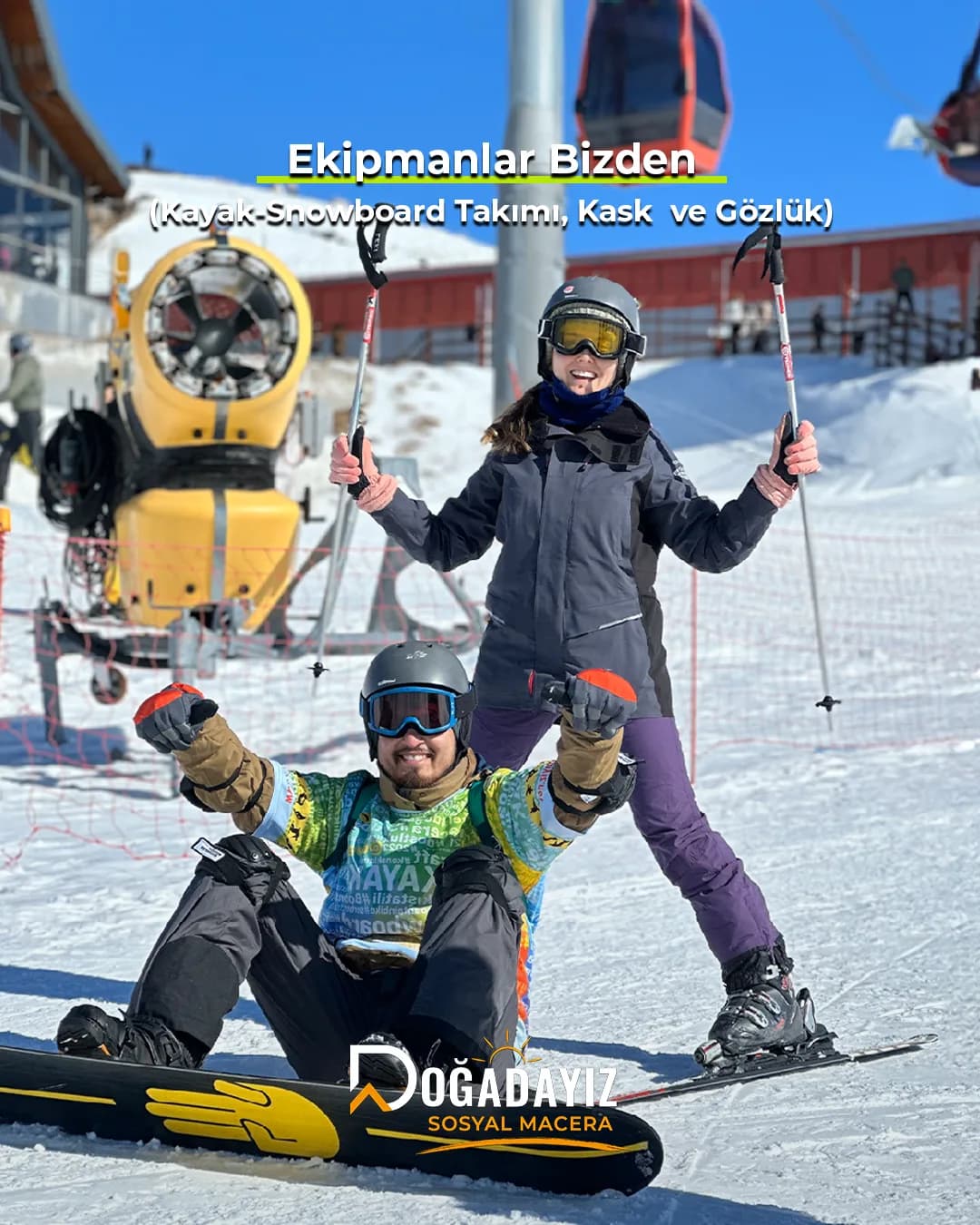
On your first ski holiday, you do not need to worry about choosing skis: on an activity holiday, equipment is included in the package and set up at the rental shop according to your height, weight and level. A ski or snowboard set is part of every Doğadayız winter package; the Erciyes basic course packages also include a helmet, goggles and protective gear. Your instructor also checks on the first day whether the skis suit you. Learning with people at the same level turns the programme into a social adventure holiday; for programmes, see our winter activity holidays page.
Doğadayız Packages
Doğadayız packages for your level
Winter activity holidays with accommodation, ski pass and equipment included, shared with a group.
The easiest way to learn to ski: a winter activity holiday
An activity holiday puts a sport at the heart of your trip: transport, accommodation and meals are planned, so you can focus on learning on the slopes. On Doğadayız winter activity holidays, accommodation, ski pass and ski or snowboard equipment are included in every package; course packages include basic lessons with instructors affiliated with the Turkish Ski Federation, while experience packages let you practise on the slopes at your own level.
What makes the programme different is the group: sharing the slopes with people at a similar level, dinners and nights out together, and a group leader by your side at all times. Solo travellers become part of this social adventure holiday from day one. That is why we describe our programmes as a social adventure holiday.
For a beginner, skis are usually chosen at chin height or 10–15 cm shorter than your height. Manufacturers' recommendations differ slightly: Atomic recommends about chin height, Salomon 15 cm shorter than your height, and Head between the chin and the nose.
Does weight or height determine ski length?
Both together, but your level matters a lot too. Light and inexperienced skiers should choose the shorter end, heavy or sporty skiers the longer end.
Are short or long skis easier?
Short skis turn more easily and make speed control more comfortable, which is why they suit beginners. Long skis are more stable at high speed and are preferred by advanced skiers.
Should I buy skis in my first season?
Usually not. Renting in your first season lets you find out which length and style suit you. If you are going to buy, it makes more sense to invest first in boots that fit your feet perfectly.
When choosing ski boots, you look at four things: size, flex (stiffness), last width and fit. Ski boot sizes are given in the Mondopoint system: your foot length in centimetres (e.g. 26.5). For beginners, a soft to medium flex is recommended; Nordica gives this range as 40–80, while Atomic puts it at the lower end of a scale starting at around 70, but there is no common measuring standard for flex across brands. The most common mistake is buying boots that are too big: according to Atomic's shell test, 2 cm of space behind the heel in the boot with the liner removed is right for most skiers, and 3 cm is too big.
For a beginner, the right approach is to rent in your first season. According to Burton, while you are learning you should prioritise lessons over new equipment, rent your gear and invest once you have learned the basics. When you decide to buy, the usual order is: first personal items (helmet, goggles, gloves, socks), then boots that fit your feet perfectly, and skis or a snowboard last. The main risk with rental equipment is a poor setting: for short-term rentals, the binding should be set by a technician according to ISO 13993. On a winter activity holiday package, equipment is usually already included.
You start skiing with a beginner lesson with an instructor, rental equipment and easy (beginner) slopes. On day one you put on your skis, glide on flat ground, learn to stop with the snowplough and ride the magic carpet; on day two you come down an easy slope under control with snowplough turns. For an adult who has never skied, this stage usually takes 2 days.