Snowboard Freestyle Disciplines: Park, Halfpipe, Slopestyle and Big Air
The main competition disciplines in snowboard freestyle are halfpipe (a series of aerial tricks in a snow channel with two walls), slopestyle (a course with rails, boxes and jumps), big air (a single trick off one big jump) and street style (rails and street-style obstacles). Under the FIS World Cup standards, halfpipe walls are 6.7 metres high. Judges generally assess a run on difficulty, amplitude, variety and execution, with a single overall impression score out of 100. For recreational riders, freestyle starts in the snowpark; in one study, the riskiest park features for snowboarders were jumps and the halfpipe, and the least risky were rails.
In its 2026 competition rules, the International Ski and Snowboard Federation (FIS) lists halfpipe, slopestyle, big air and street style among the snowboard disciplines. The speed disciplines, snowboard cross and parallel races, are also governed by FIS, but they are racing disciplines, not freestyle.
Discipline
Terrain
What do riders do?
At the Olympics
Halfpipe
A channel made of two facing snow walls
A series of aerial tricks while crossing from one wall to the other
Since Nagano 1998
Slopestyle
A course of rails, boxes and jumps
One trick on each feature; the course is judged as a whole
Since Sochi 2014
Big air
One big jump
A single trick, as difficult and clean as possible
According to the FIS World Cup halfpipe standards:
Measurement
Value
Wall height
22 feet, or 6.7 metres
Slope angle
18° ± 1°
Rideable wall length
More than 150 metres
Width
19–21 metres (narrower if the slope is gentler, wider if it is steeper)
Top deck
At least 8 metres
These dimensions are the World Cup target; actual wall heights at competitions vary slightly from venue to venue. The rider rises out of one wall, does a trick in the air, lands back on the same wall and crosses to the opposite wall.
Slopestyle
In slopestyle, the rider comes down a course that combines rail and box sections with jumps one after another. One trick is done on each feature, and the judges assess the course as a whole: the difficulty of the tricks, how different they are from each other, clean landings and a flowing use of the course. A recreational snowpark is in fact a small-scale slopestyle course.
Big air
In big air, the rider does a single trick off one big jump. The judges look at the difficulty of the trick, its amplitude and how clean the landing is. You can find trick types such as spins and grabs in the glossary entries spin and grab.
What do judges look for?
The guide that Canada Snowboard prepared for its regional judges (it describes itself not as an official rulebook but as a pocket guide) sums up the main criteria with the acronym DAVE:
Criterion
Meaning
Difficulty
The technical difficulty of the trick
Amplitude
How high the rider goes; measured from the rider's waist
Variety
Variety of tricks, spin directions and grabs
Execution
Cleanliness, control and landing
In addition, progression, risk, combinations and, in the halfpipe, use of the pipe are deciding factors. Each run is assessed with a single overall impression score out of 100.
Park features
Feature
What is it?
Kicker
A jump ramp; a table-top kicker has a flat top section between the take-off and the landing
Box
A wide, flat-topped box you slide along; more forgiving than a rail
Rail
A narrow pipe or rail you slide along
Halfpipe and quarter-pipe
A pipe, or a single half wall
We explain the beginner tricks (ollie, press, butter and the 50-50 on a box) in our guide Ollies, Nollies and Basic Freestyle Skills on a Snowboard, and the park safety rules in the Park Smart section of the same guide. At many resorts, park features are marked by size; AASI, the American association of snowboard instructors, also matches rider levels to features in a progression that starts with the smallest (XS–S) features and goes up to medium (M) features.
Which features are riskier?
In a case-control study by Russell and colleagues, who followed snowboarders in a snowpark in the Canadian province of Alberta over two seasons:
Feature
Injuries per 1,000 runs
Jumps
2.56
Halfpipe
2.56
Rails
0.43
Quarter-pipe
0.24
Overall
0.75
Compared with rails, the odds of injury were about 10 times higher in the halfpipe and about 4 times higher on jumps. In the same team's case series, the most commonly injured area was the wrist (20%) and the most common type of injury was a fracture (36%); head-and-neck and torso injuries were more likely on features where riders are airborne. These results apply only to snowboarders and to a single park. We explain how to protect yourself against wrist and head injuries in our guides Preventing Wrist, Shoulder and Head Injuries in Snowboarding and Back, Wrist and Hip Protectors.
Your first steps in the park
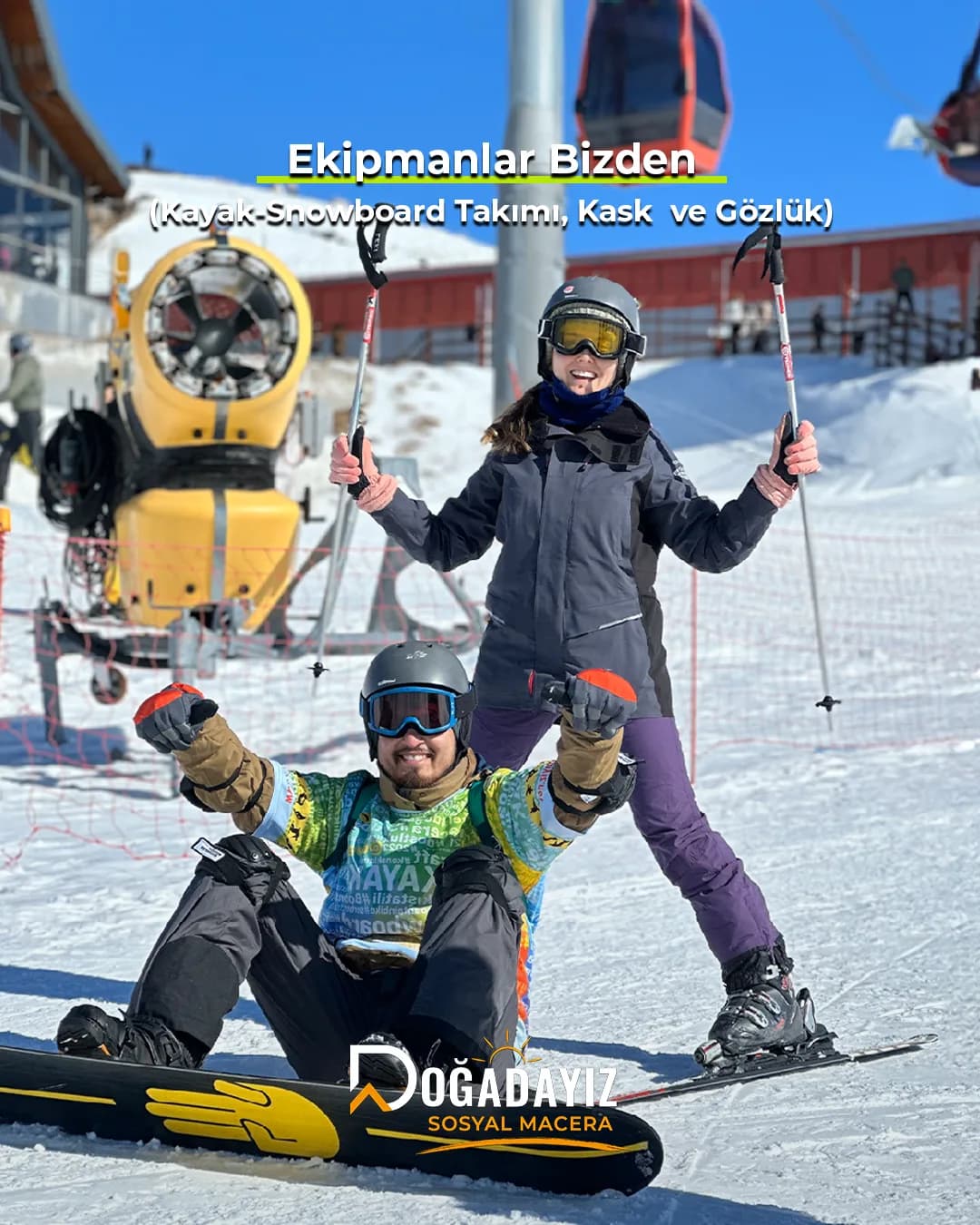
Watching freestyle is exciting; trying it is safe when you go in the right order. On an activity holiday, the right path is to get linked turns solid first, then ollies and presses on flat ground, and to start with the smallest box. Doğadayız winter packages include accommodation, ski pass and equipment; lessons with an instructor come with the basic course packages. Watching each other from the side of the park and celebrating your first 50-50 together is one of the unforgettable moments of a social adventure holiday. To check your level, see our Snowboard Skills Checklist; for programmes, see our winter activity holidays page.
Doğadayız Packages
Doğadayız packages for your level
Winter activity holidays with accommodation, ski pass and equipment included, shared with a group.
The easiest way to learn to ski: a winter activity holiday
An activity holiday puts a sport at the heart of your trip: transport, accommodation and meals are planned, so you can focus on learning on the slopes. On Doğadayız winter activity holidays, accommodation, ski pass and ski or snowboard equipment are included in every package; course packages include basic lessons with instructors affiliated with the Turkish Ski Federation, while experience packages let you practise on the slopes at your own level.
What makes the programme different is the group: sharing the slopes with people at a similar level, dinners and nights out together, and a group leader by your side at all times. Solo travellers become part of this social adventure holiday from day one. That is why we describe our programmes as a social adventure holiday.
The main ones are halfpipe (a series of aerial tricks in a snow channel with two walls), slopestyle (a course of rails, boxes and jumps), big air (a single trick off one big jump) and street style (rails and street-style obstacles). Halfpipe has been Olympic since 1998, slopestyle since 2014 and big air since 2018.
How high is a halfpipe wall?
Under the FIS World Cup standards, the wall height is 22 feet, or 6.7 metres; the slope angle is 18° ± 1°, the width 19–21 metres and the rideable length more than 150 metres. The dimensions of halfpipes at ski resorts vary from resort to resort.
How is snowboard freestyle scored?
Judges generally look at the main criteria of difficulty, amplitude, variety and execution (DAVE), and at deciding factors such as progression, risk, combinations and, in the halfpipe, use of the pipe. Each run is assessed with a single overall impression score out of 100.
An ollie is a controlled jump powered by the tail of the snowboard: you shift your weight onto your back foot, flex the tail, pull your front foot and knees up as the board springs back, and land on both feet at the same time with the base flat. A nollie is the same move done from the nose. According to NZSIA, the progression starts on flat ground: first pressing the tail to lift the nose (wheelie), then jumping with both feet, then combining the two. The next steps in freestyle are presses, the 50-50 on a low box and small jumps. Before going into a terrain park, learn the Park SMART rules of the US ski areas association NSAA: start small, make a plan, always look, respect, take it easy. Research shows that the risk of head, neck and back injuries is higher in the park, which is why a helmet and gradual progression are essential.
The main riding styles in skiing and snowboarding are piste (turning technique on groomed, marked runs), all-mountain (every condition, from the piste to soft snow and bumps), freeride (natural off-piste terrain and deep snow), freestyle (snowpark, jumps, rails and halfpipe), ski touring and splitboarding (climbing up the mountain without lifts) and racing (timed disciplines from slalom to downhill). The International Ski and Snowboard Federation (FIS) recognises dozens of competition events under alpine skiing, freestyle and snowboard, and in 2024 it added freeride to its official disciplines. For a beginner, the right start is piste skiing, followed by all-mountain.
Snowboards fall into four main types depending on the terrain they are made for. All-mountain boards, in Burton's definition, are designed for good performance on any terrain, including groomed runs, the park and powder; most beginner boards are in this category too. Freestyle (park) boards usually have a twin shape, meaning the nose and tail are identical, which makes riding and landing switch easier. Freeride boards are usually directional and stiffer, for off-piste riding and speed. Powder boards have a wide nose, a tail that narrows (taper) and bindings set back towards the tail (setback), so they float in deep snow. For a beginner, the right choice is often a soft, all-mountain board.