Snowboard Types: All-Mountain, Freestyle, Freeride and Powder Boards Compared
Snowboards fall into four main types depending on the terrain they are made for. All-mountain boards, in Burton's definition, are designed for good performance on any terrain, including groomed runs, the park and powder; most beginner boards are in this category too. Freestyle (park) boards usually have a twin shape, meaning the nose and tail are identical, which makes riding and landing switch easier. Freeride boards are usually directional and stiffer, for off-piste riding and speed. Powder boards have a wide nose, a tail that narrows (taper) and bindings set back towards the tail (setback), so they float in deep snow. For a beginner, the right choice is often a soft, all-mountain board.
Often directional or directional twin; medium flex
Beginners and most riders who want a single board
Freestyle (park)
Snowpark, halfpipe, switch
Twin or true twin; often soft and playful (there are stiff park models too)
Riders focused on the park and switch
Freeride
Off-piste, steep terrain, speed
Usually directional, stiffer, often with setback
Experienced riders who ride off-piste
Powder
Deep fresh snow
Wide nose, taper, pronounced setback
Riders who chase powder days
Burton's guide defines the all-mountain, park and powder categories; freeride is a category widely used in the industry for off-piste and steep terrain.
Shape terms
Twin: The nose and tail have the same shape; the board feels the same in both directions.
True twin: According to the manual of the New Zealand instructors' association (NZSIA), a board whose shape and flex are both identical at the nose and tail; designed especially for the park. NZSIA also points out that many boards sold as "twin" have a twin shape but a directional flex.
Directional: The board has a front and a back. According to NZSIA, most snowboards have a directional flex.
Setback: The bindings are moved towards the tail relative to the centre of the board; this helps the nose rise in powder.
Taper: The tail is narrower than the nose; this gives the board float and a "surfy" feel in powder.
First season: According to Burton, beginner boards have a simple shape, a soft flex and a profile that reduces edge catches; many of them are already in the all-mountain category. Renting a board in your first season is often the most sensible option; see Should you rent or buy?.
Riders heading for the park: A soft freestyle board, twin or true twin. To start riding switch, see our guide Riding switch on a snowboard.
Riders heading off-piste: A directional, stiffer freeride or powder board; but avalanche knowledge and equipment come first. See Avalanche risks when skiing off-piste.
Length: According to NZSIA, board length is chosen not just by height but by the manufacturer's weight range.
Splitboard
A splitboard is a snowboard that splits into two skis: you fit climbing skins to the base and climb the mountain, then at the top you join the two halves and ride down as a snowboard. It is a mountain discipline that requires avalanche training and equipment.
Trying different boards
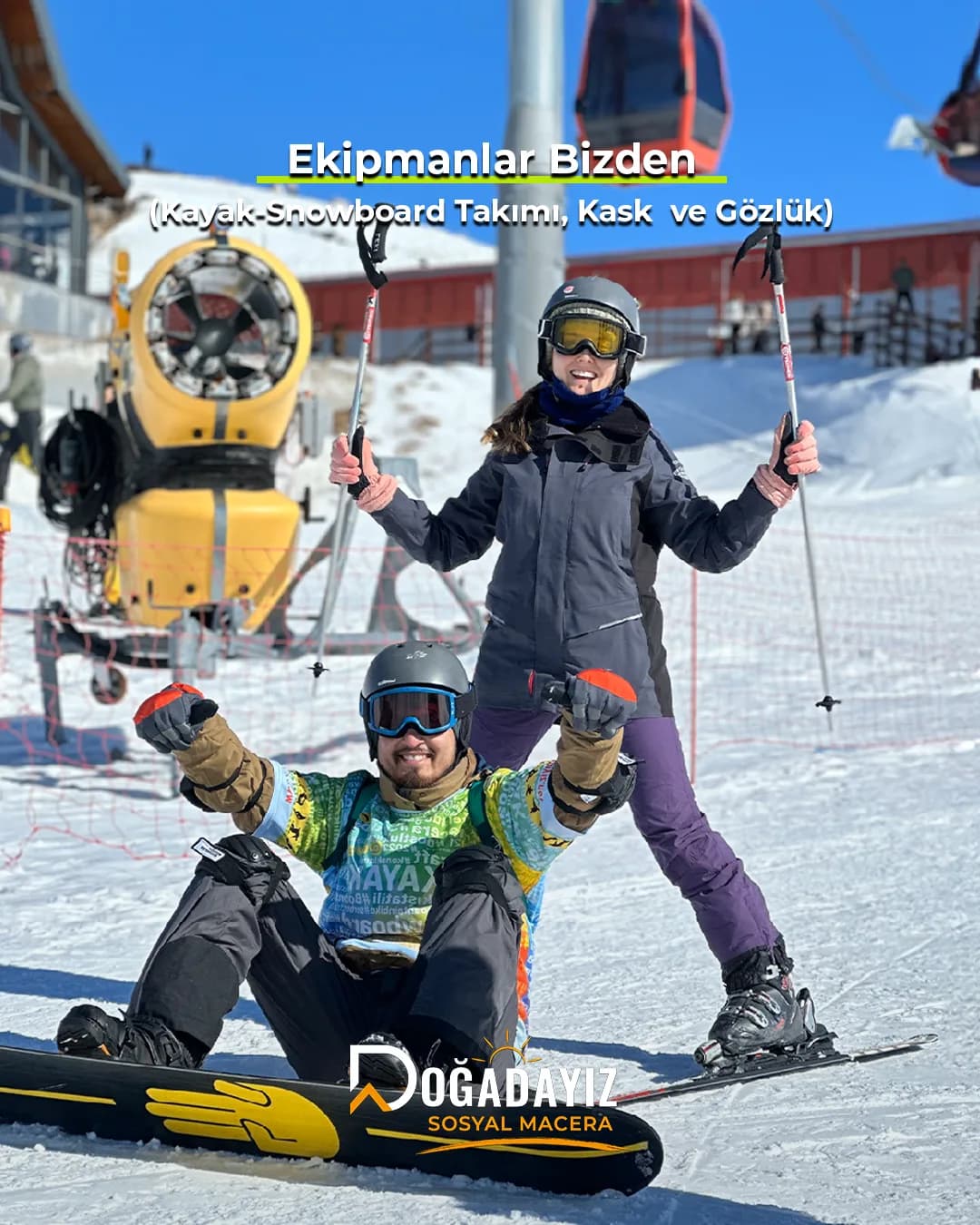
The best way to decide on your own board is to try different types first. On an activity holiday, the equipment rental shop gives you that chance: on Doğadayız winter packages, snowboard equipment is included. Talking about boards and the day with the group in the evenings turns the programme into a social adventure holiday; for programmes, see the winter activity holidays page.
Doğadayız Packages
Doğadayız packages for your level
Winter activity holidays with accommodation, ski pass and equipment included, shared with a group.
The easiest way to learn to ski: a winter activity holiday
An activity holiday puts a sport at the heart of your trip: transport, accommodation and meals are planned, so you can focus on learning on the slopes. On Doğadayız winter activity holidays, accommodation, ski pass and ski or snowboard equipment are included in every package; course packages include basic lessons with instructors affiliated with the Turkish Ski Federation, while experience packages let you practise on the slopes at your own level.
What makes the programme different is the group: sharing the slopes with people at a similar level, dinners and nights out together, and a group leader by your side at all times. Solo travellers become part of this social adventure holiday from day one. That is why we describe our programmes as a social adventure holiday.
Most often a soft-flexing, all-mountain board. According to Burton, many beginner boards are already in the all-mountain category; renting in your first season also makes sense.
What is the difference between a twin and a directional snowboard?
A twin board has an identical nose and tail and feels the same in both directions; it is ideal for the park and switch. A directional board has a front and a back and is usually designed for riding in one direction and for off-piste.
Why is a powder snowboard different?
To float in deep snow, it has a wide nose, a shape that narrows towards the tail (taper) and a setup with the bindings moved towards the tail (setback); these help keep the nose on top of the snow.
When choosing your first snowboard, weight matters more than height: according to Burton, the board only “knows” your weight and your boot size, and manufacturers' weight ranges are recommendations, not rules. A practical starting point is a length that comes between your chin and nose when the board is stood upright; for beginners, Ride finds a slightly shorter board more forgiving. If your boot size is large (men's US 11–12 and above), you may need a wide board; otherwise your toes and heels drag in the snow. For a beginner, soft flex and a forgiving profile (according to Burton, a soft flat profile) make the easiest start. Renting in your first season is the best choice.
Snowboard boots should fit snugly but without hurting, and your heel should not lift. According to Burton, do not assume your everyday shoe size; wear the boots and walk around for 5–10 minutes. When you bend your knees, your toes should lightly touch the end of the liner, and if your heel lifts with the boots fully laced, try half a size smaller. For beginners, a soft and forgiving flex is best. There are three lacing options: traditional laces (full control), BOA (even tightening with a dial, adjustable with gloves on) and two-zone speed lacing. In your first season you can rent boots too; what matters is the right size and fit.
Riding switch means riding with your usual stance reversed, i.e. with your other foot forward: a regular rider rides goofy, and a goofy rider rides regular. According to the New Zealand instructors' association (NZSIA), switch is essential for many freestyle moves and also makes you a more versatile rider in freeride. The learning sequence is similar to basic training: on a flatter green run, start with a switch traverse, then the garland, C-turns and finally linked switch turns. Setting up your bindings duck (front foot angled towards the nose, back foot towards the tail, e.g. +15/−15 or +8/−8) evens out both directions. In NZSIA's comparison, learning switch is like learning to write with your other hand: it feels clumsy at first and improves with patience.