When Should You Wear Back, Wrist and Hip Protectors?
Of all protectors, the one whose effect is best proven is the snowboard wrist guard. According to a systematic review, the risk of wrist injury in snowboarders who wear wrist guards falls to about a quarter (RR 0.23); in other words, one wrist injury is prevented for every 50 snowboarders who wear wrist guards. In a randomised controlled trial there were 8 wrist injuries in the group with guards and 29 in the group without. Wrist guards are especially recommended for beginners in their first few days and for people using rental equipment; these two groups get injured more often. For back protectors and hip/tailbone pads, on the other hand, there is no strong evidence that they reduce injuries; they can be chosen for comfort and confidence in the snowpark and on the first days, when you fall a lot. No protector replaces a helmet.
One of the most commonly injured areas in snowboarding is the wrist: when you fall forwards or backwards, your hands reach for the ground by reflex. In skiing, knee injuries stand out. We explain the injury risks area by area in our guides Preventing Wrist, Shoulder and Head Injuries in Snowboarding and Knee Injuries in Skiing. This article focuses on how well protectors actually work.
The evidence at a glance
Protector
Evidence
Result
Snowboard wrist guard
Systematic review (Russell et al. 2007), randomised controlled trial (Rønning et al. 2001), case-control study (Hagel et al. 2005)
Strong: the risk of wrist injury falls to about a quarter
How effective are they? The 2007 systematic review by Russell, Hagel and Francescutti pooled the studies and reached the following results:
Wrist injury: RR 0.23 (about 77% lower risk).
Wrist fracture: RR 0.29; sprain: RR 0.17.
In the authors' words: one wrist injury is prevented for every 50 snowboarders who wear wrist guards.
In a randomised controlled trial with 5,029 snowboarders in Norway (Rønning et al. 2001), there were 8 wrist injuries in the group with guards and 29 in the group without. In the same study, beginners in their first five days and people using rental equipment were injured more often.
Does the injury just move elsewhere? This question is debated. In Hagel et al. 2005, wrist guard wearers appeared more likely to injure their elbow or shoulder, but the difference was not statistically significant.
How to choose one? There is a separate standard for wrist guards designed for snowboarding: ISO 20320. There are models worn under or over the glove, as well as gloves with built-in protection. The guard should hold the wrist firmly without squeezing it and be comfortable to use together with your gloves.
Back protectors
Back protectors are usually tested to the EN 1621-2 standard, which was developed for motorcycling. According to SATRA, at Level 1 the average force transmitted through the protector must be below 18 kN; at Level 2 this value is 9 kN or less. The lower the transmitted force, the better the protection. We could not find a back protector standard specific to snow sports.
In a retrospective cohort study (Tinner et al. 2025), back protectors did not prevent spinal injuries and did not reduce multiple trauma. This does not prove conclusively that back protectors are useless, but it does mean their effect in skiing and snowboarding has not been proven. People who ride in the snowpark, in the trees or at high speed may still choose to wear one.
Hip and tailbone pads
When you learn to snowboard, you fall most often backwards, onto your tailbone. Hip pads and impact shorts can make these falls less painful, but there is no controlled study showing that they reduce injuries. They are worth considering for comfort and confidence. Learning to fall correctly, though, comes before any protector: see our guide How to Fall and Get Up Safely on a Snowboard.
Who should wear what?
Who?
Recommendation
Snowboard beginner (first days)
Helmet + wrist guards; hip pads if you like
Snowboarder on rental equipment
Wrist guards (higher risk)
Anyone riding in the snowpark
Helmet + wrist guards; a back protector is an option
Intermediate skier on the pistes
Helmet; other protectors are a personal choice
A week of learning safely
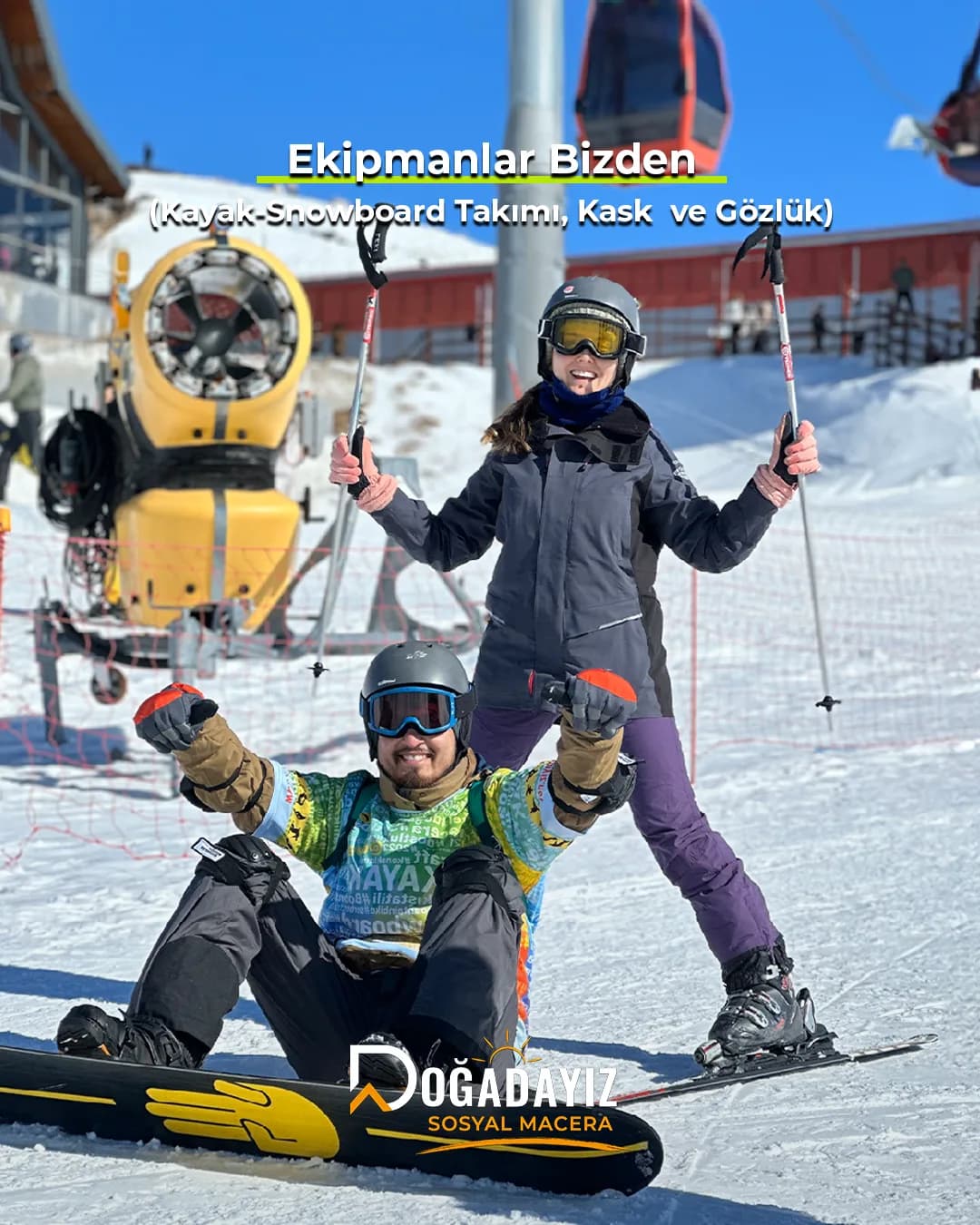
Your first days on a snowboard are the days you fall the most, so it is wise to start an activity holiday with a helmet and wrist guards. Doğadayız winter packages include accommodation, ski pass and ski or snowboard equipment; basic course packages also include lessons with an instructor. Helping someone who started snowboarding on the same day back to their feet and laughing together at those first falls is one of the best-loved moments of a social adventure holiday. For programmes, see our winter activity holidays page.
Doğadayız Packages
Doğadayız packages for your level
Winter activity holidays with accommodation, ski pass and equipment included, shared with a group.
The easiest way to learn to ski: a winter activity holiday
An activity holiday puts a sport at the heart of your trip: transport, accommodation and meals are planned, so you can focus on learning on the slopes. On Doğadayız winter activity holidays, accommodation, ski pass and ski or snowboard equipment are included in every package; course packages include basic lessons with instructors affiliated with the Turkish Ski Federation, while experience packages let you practise on the slopes at your own level.
What makes the programme different is the group: sharing the slopes with people at a similar level, dinners and nights out together, and a group leader by your side at all times. Solo travellers become part of this social adventure holiday from day one. That is why we describe our programmes as a social adventure holiday.
Yes. According to a systematic review, the risk of wrist injury in snowboarders who wear wrist guards falls to about a quarter (RR 0.23); one wrist injury is prevented for every 50 users. They are especially recommended for beginners and people using rental equipment.
Do you need a back protector for skiing and snowboarding?
It is not mandatory. A retrospective cohort study could not show that back protectors prevent spinal injuries. People who ride in the snowpark or at high speed may wear one as a personal choice; a helmet, however, is the priority in every case.
Should I buy hip pads (impact shorts)?
There is no controlled study showing that they reduce injuries. Snowboard beginners fall backwards often, so they may choose them for comfort; learning the right falling technique is more important.
The pattern of injuries in snowboarding is different from skiing: in skiing the knee comes first, in snowboarding the wrist. In an 18-season study in the US state of Vermont, wrist injuries made up 27.6% of all snowboarding injuries but only 2.8% of skiing injuries; shoulder and collarbone injuries and concussions were also more common among snowboarders. The good news is that the most common injury is also the easiest one to prevent: according to a systematic review pooling 6 studies, wrist guards cut the risk of wrist injury to roughly a quarter. Among helmet wearers, the likelihood of a head injury is about 35% lower. Because beginners are injured more often, wearing protection in the first days and learning how to fall properly matters.
When choosing a ski helmet, check three things: certification, fit and goggle compatibility. In Europe the standard for ski and snowboard helmets is EN 1077 (class A covers the ears and has a stricter penetration test; class B offers more ventilation and better hearing); in the USA it is ASTM F2040. The helmet should fit snugly but without hurting, stay put when you shake your head, and leave room for two fingers under the chin strap. According to a meta-analysis of 12 studies, helmet wearers are about 35% less likely to suffer a head injury, and neck injuries do not increase. After a serious impact, a helmet should be replaced even if there is no visible damage.
Falling is a natural part of learning to snowboard; what matters is falling correctly. The most important rule: don't try to catch yourself with your hands. According to Burton, you should pull your arms in and take the impact with large, fleshy areas such as your forearms, elbows and bottom, roll with the momentum and tuck your chin to your chest when falling backwards. According to the New Zealand Snowsports Instructors Alliance (NZSIA), when you feel you are going to fall, make loose fists, get low and stay relaxed. This matters because the wrist is the most commonly injured area in snowboarding injuries and the main mechanism is falling; wrist guards also reduce wrist injuries significantly.