How to Choose Ski Socks: Foot Comfort and Boot Fit
The best choice for skiing and snowboarding is usually a single, thin or medium-thickness, cotton-free (wool, merino or synthetic blend) sock that comes up above the boot cuff. Ski boots are designed to fit snugly; as PSIA warns, a sock that wrinkles or is too thick inside the boot leads to pressure and rubbing, and a thick sock can also restrict circulation. Cotton holds moisture and stretches and wrinkles when wet; in a double-blind study, acrylic socks were associated with fewer blisters than cotton. Wearing two thick socks does not warm your feet; it usually does the opposite.
A ski boot is a hard shell that wraps your foot tightly; it does not stretch like an everyday shoe. So the sock is the only thin layer between boot and foot, and a small mistake affects the whole day. The instructor guide of PSIA, the Professional Ski Instructors of America, sums it up in one sentence: a sock that wrinkles or is too thick and bulky inside the boot can turn into torture.
We cover choosing boots in our guides to ski boots and snowboard boots; the right sock complements the right boot.
Selection table
Feature
Recommendation
Why?
Thickness
Thin or medium
There is no room for a thick sock in a boot of the right size; a thick sock gets squashed and can restrict circulation
Material
Wool, merino or synthetic blend
Cotton holds moisture, stretches and wrinkles when wet
Length
Long enough to come up above the boot cuff
The edge of the cuff does not rub against bare leg or the top of the sock
Number
One sock
Two socks slip, wrinkle and make the boot tighter
Why not cotton?
According to the sock guide of the American Academy of Podiatric Sports Medicine (AAPSM), cotton fibre holds roughly three times as much moisture as acrylic fibre; a wet cotton sock stretches, loses its shape and wrinkles. And a wrinkled sock means friction and blisters.
The evidence comes from runners: in Herring and Richie's 1990 double-blind study with 35 long-distance runners, socks that were identical in every way except the fibre were compared; acrylic socks were associated with fewer and smaller blisters than 100% cotton socks. There is no similar study with ski socks; but the logic of moisture and friction applies in a ski boot too.
Thin or thick?
Buying thick socks to stay warm seems logical, but in a ski boot it often works the other way:
According to boot specialist Profeet, there is no room for a thick ski sock in a boot of the right size.
According to equipment retailer REI, a thick sock can squeeze the foot and restrict circulation; a foot with less blood flow gets cold more quickly.
When a boot has become loose, filling it with a thick sock is not the answer; your foot keeps moving around inside the boot. If there is room, ask a boot fitter about adjusting the boot or the liner.
If your feet get cold quickly, first check whether the boot is too tight, whether your sock is wet and whether the buckles are done up tighter than necessary. We cover ways of dealing with the cold in our guide ski gloves and keeping warm.
Can you wear two pairs of socks?
Here the evidence comes from two different places, and they should not be mixed up:
Military hiking boots: In Knapik and colleagues' 1996 study with 357 military recruits, blisters occurred in 40% of the group using a thick wool-polypropylene sock and a polyester liner sock, 69% with the standard sock, and 77% with the standard sock plus a liner sock. In Van Tiggelen and colleagues' 2009 study, sock type also predicted blisters. So in a hiking boot, a properly designed sock system can make a difference.
Ski boots: In a tight-fitting hard shell, a second sock means slipping and wrinkling between the layers and a tighter boot. The common recommendation of boot fitters and retailers is a single thin sock.
In short, the military findings cannot be transferred directly to ski boots; stick to one sock for skiing.
Do compression socks help?
The study on compression for skiers that we found is Sperlich and colleagues' 2013 laboratory study with 12 elite alpine skiers. In a simulated 3-minute racing tuck, leg compression reduced the change in knee angle and the oscillation and lowered perceived effort; but it had no effect on strength, jumping and balance. This study was done in a laboratory, not on the slopes, and with a leg compression garment, not ski socks. We found no evidence showing a benefit of compression socks for recreational skiers; if you find them comfortable you can wear them, but do not expect them to be a performance tool.
Sock habits on the slopes
Pull your sock on without wrinkles before you get into the boot; make sure there is no fold, especially at the heel and ankle.
Change your socks at the end of the day; start the next morning with a dry pair.
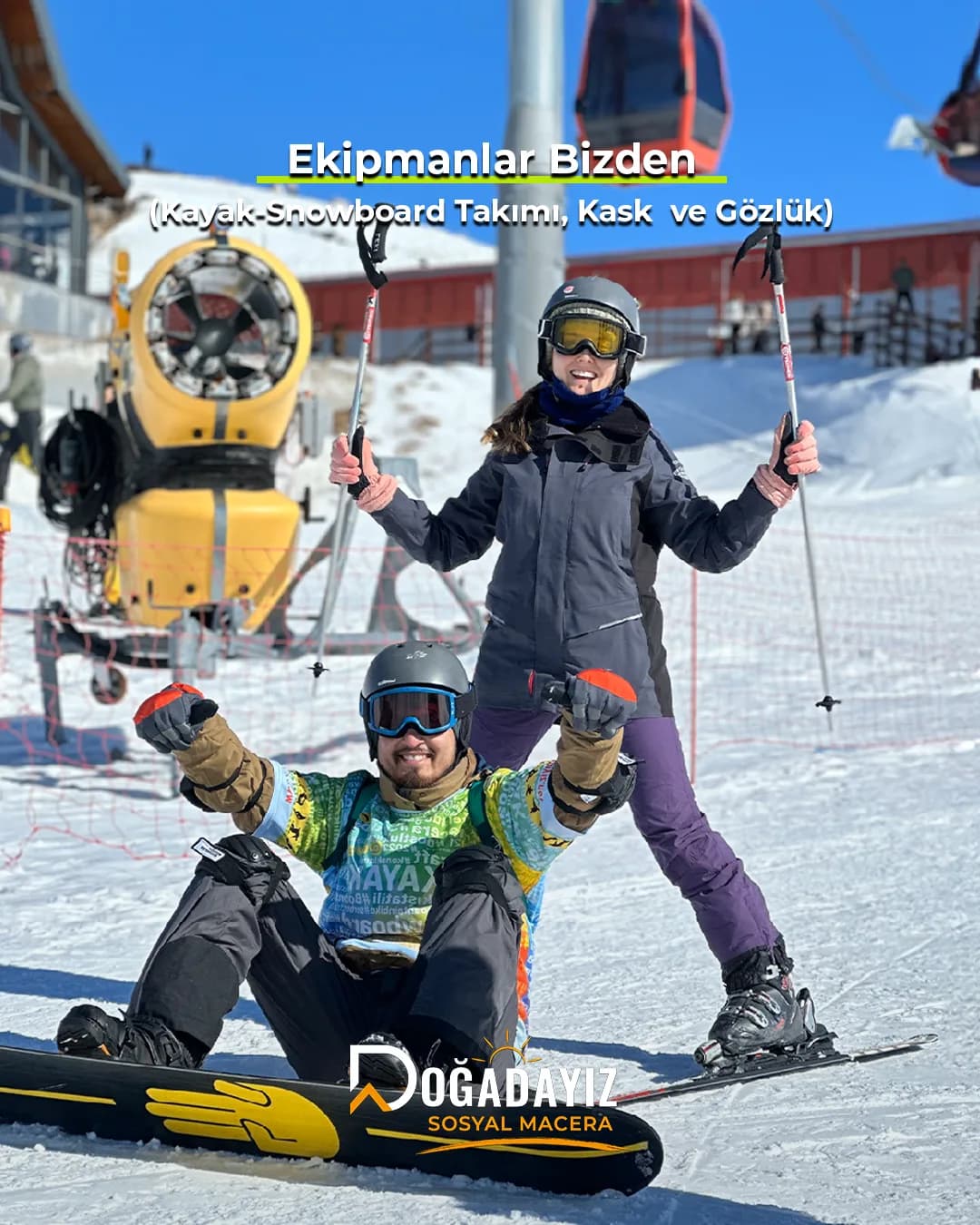
Someone whose feet do not hurt stays on the slopes in the afternoon too; this is one of the small details that make the biggest difference on an activity holiday. Doğadayız winter packages include accommodation, a ski pass and ski or snowboard equipment; all you need to bring is your socks. Leaving wet socks to dry in the evening and talking through the next day's plan with your new friends is also part of a social adventure holiday. For programmes, see our winter activity holidays page.
Doğadayız Packages
Doğadayız packages for your level
Winter activity holidays with accommodation, ski pass and equipment included, shared with a group.
The easiest way to learn to ski: a winter activity holiday
An activity holiday puts a sport at the heart of your trip: transport, accommodation and meals are planned, so you can focus on learning on the slopes. On Doğadayız winter activity holidays, accommodation, ski pass and ski or snowboard equipment are included in every package; course packages include basic lessons with instructors affiliated with the Turkish Ski Federation, while experience packages let you practise on the slopes at your own level.
What makes the programme different is the group: sharing the slopes with people at a similar level, dinners and nights out together, and a group leader by your side at all times. Solo travellers become part of this social adventure holiday from day one. That is why we describe our programmes as a social adventure holiday.
Usually a single thin or medium-thickness sock. Ski boots are designed to fit snugly; a thick sock gets squashed, can wrinkle and, by restricting circulation, can make your feet get cold more quickly.
Can you wear cotton socks for skiing?
It is not recommended. According to the AAPSM, cotton holds roughly three times as much moisture as acrylic and stretches and wrinkles when wet. In a double-blind study with runners, acrylic socks were associated with fewer blisters than cotton. Wool, merino or a synthetic blend should be preferred.
Can you wear two socks with ski boots?
In ski boots, usually not. The second sock slips between the layers, wrinkles and makes the boot tighter. There are studies showing that liner and dense sock systems reduce blisters in military hiking boots, but these findings cannot be transferred directly to hard ski boots.
When choosing ski boots, you look at four things: size, flex (stiffness), last width and fit. Ski boot sizes are given in the Mondopoint system: your foot length in centimetres (e.g. 26.5). For beginners, a soft to medium flex is recommended; Nordica gives this range as 40–80, while Atomic puts it at the lower end of a scale starting at around 70, but there is no common measuring standard for flex across brands. The most common mistake is buying boots that are too big: according to Atomic's shell test, 2 cm of space behind the heel in the boot with the liner removed is right for most skiers, and 3 cm is too big.
Snowboard boots should fit snugly but without hurting, and your heel should not lift. According to Burton, do not assume your everyday shoe size; wear the boots and walk around for 5–10 minutes. When you bend your knees, your toes should lightly touch the end of the liner, and if your heel lifts with the boots fully laced, try half a size smaller. For beginners, a soft and forgiving flex is best. There are three lacing options: traditional laces (full control), BOA (even tightening with a dial, adjustable with gloves on) and two-zone speed lacing. In your first season you can rent boots too; what matters is the right size and fit.
For skiing and snowboarding you wear three layers: a synthetic or wool base layer that wicks sweat away, a fleece mid-layer that holds in warmth, and a ski jacket and trousers that keep out wind and water. Add a single pair of thin ski socks, waterproof gloves, a neck gaiter, a helmet and goggles. Do not wear cotton: it gets soaked with sweat and makes you cold.