The Basic Snowboard Stance: Stance, Balance and Weight Distribution
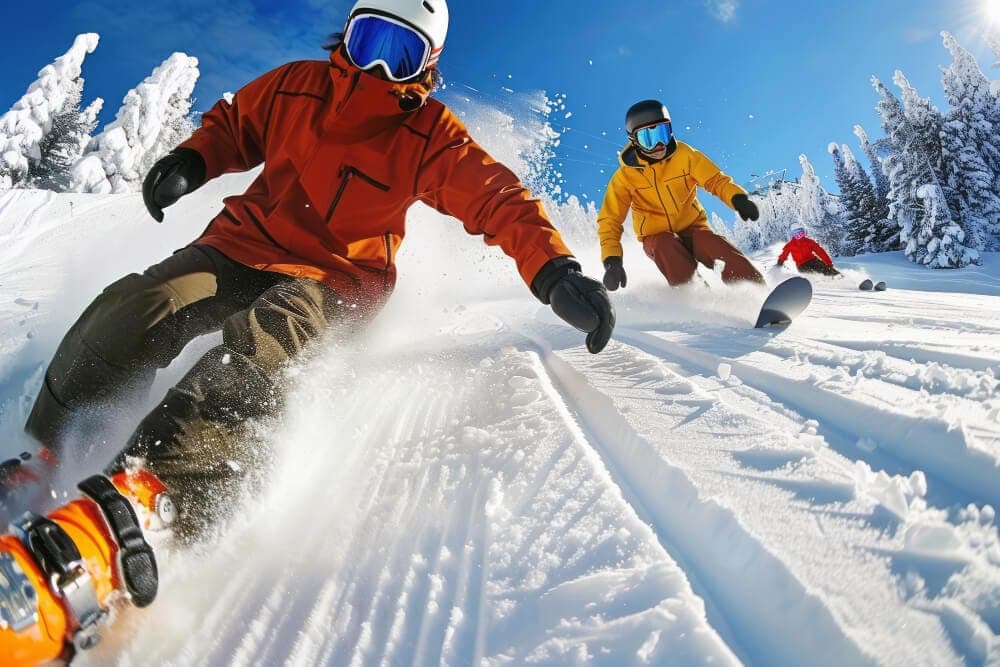
The basic snowboard stance, as defined by the New Zealand Snowsports Instructors Alliance (NZSIA), is a position slightly lower and more flexed than normal standing: feet about shoulder-width apart, weight evenly on both feet; ankles, knees and hips relaxed and slightly flexed; hips and shoulders aligned with the direction of your feet and the board's edge; upper body upright, arms relaxed at your sides; head and eyes turned in the direction of travel. On the heelside, your hips shift slightly towards your heels; on the toeside, your ankles and knees flex more. The two most common mistakes are leaning back towards the tail out of fear and trying to create edge angle by tilting your whole body.
Slightly low and flexed: Slightly lower than normal standing.
Even weight: Distributed evenly over both feet.
Relaxed joints: Ankles, knees and hips relaxed and slightly flexed.
Alignment: Hips and shoulders aligned with the direction of your feet and of the edge in contact with the snow; shoulders over the board.
Upper body and arms: Upper body upright, arms relaxed at your sides.
Gaze: Head turned, eyes in the direction of travel, not on your feet.
NZSIA also points out that everyone's basic stance will be slightly different; height, flexibility and preference all affect it.
Stance width and angles
Width: For beginners, NZSIA recommends having your feet at the outer edge of shoulder width; another method is to measure the distance from the middle of your kneecap to the sole of your boot. According to Burton, the common starting point is shoulder width, measured from the centres of the bindings. Most boards have the manufacturer's recommended reference stance marked on them.
Angles: As a starting point, Burton recommends a set-up of around +15° on the front binding and −6° on the back; positive/zero (+/0) is also common for beginners. For details and to find out which foot goes in front, see our guide Regular or Goofy?.
Stance on the heelside and toeside
Heelside
Toeside
You face
Downhill
Uphill
Weight
Hips slightly towards your heels
On the balls of your feet
Flexion
Less in the ankles, more in the knees and hips
More in the ankles and knees, less in the hips
For riding on your edges, see our heelside and toeside guides.
Common mistakes and how to fix them (NZSIA)
Mistake
Result
Fix
Leaning back towards the tail
The board gets out of control and won't turn
Put more pressure on your front leg and foot, reach your front hand out over the nose of the board, move to easier terrain
Tilting your whole body for edge angle
Loss of balance, the edge slips
Flex with your ankles and knees on the toeside, with your knees and hips on the heelside
Looking at your feet
Balance and direction suffer
Look in the direction of travel
Locking your knees
Getting jolted on bumps
Keep your joints relaxed and slightly flexed
For the role of the front foot, see the front and back foot entry in the glossary: when riding, most of your weight is on the front foot.
From stance to your first slide
Try the stance on flat ground first, then while gliding with one foot strapped in, and finally with both feet strapped in. For the full roadmap, see our guide How to Start Snowboarding.
Day one with an instructor
Getting the correct stance right on day one makes every later step easier. On an activity holiday, the first hours are spent in the beginner area with an instructor: on Doğadayız Erciyes basic course packages, instructors affiliated with the Turkish Ski Federation (TKF) check your stance and binding set-up on day one; the snowboard set and protective gear are included. Learning with people at the same level turns the programme into a social adventure holiday.
Doğadayız Packages
Doğadayız packages for your level
Winter activity holidays with accommodation, ski pass and equipment included, shared with a group.
The easiest way to learn to ski: a winter activity holiday
An activity holiday puts a sport at the heart of your trip: transport, accommodation and meals are planned, so you can focus on learning on the slopes. On Doğadayız winter activity holidays, accommodation, ski pass and ski or snowboard equipment are included in every package; course packages include basic lessons with instructors affiliated with the Turkish Ski Federation, while experience packages let you practise on the slopes at your own level.
What makes the programme different is the group: sharing the slopes with people at a similar level, dinners and nights out together, and a group leader by your side at all times. Solo travellers become part of this social adventure holiday from day one. That is why we describe our programmes as a social adventure holiday.
According to NZSIA, slightly lower and more flexed than normal standing: weight evenly on both feet, ankles, knees and hips relaxed and slightly flexed, hips and shoulders aligned with the board, upper body upright, eyes in the direction of travel.
How far apart should my feet be on a snowboard?
For beginners, about shoulder-width apart; NZSIA recommends the outer edge of shoulder width. Most boards have the manufacturer's recommended reference stance marked on them.
Why do I keep leaning back on my snowboard?
Usually out of fear. NZSIA's fix: put more pressure on your front leg and foot, reach your front hand out over the nose of the board and practise on easier terrain.
On a snowboard, if your left foot is in front you ride regular, and if your right foot is in front you ride goofy. Both are correct; as Burton puts it, “regular doesn't mean right and goofy doesn't mean wrong”. There are three simple tests to find out which one you are: the foot you put forward when sliding on a slippery floor in your socks, and the foot you step forward with to keep your balance when someone gives you a gentle push from behind, is usually your front foot; the foot you start climbing stairs with, on the other hand, is most likely your back foot. For beginners, Burton recommends a binding set-up with the front foot positive and the back foot at zero (+/0).
You start snowboarding by finding your stance (regular or goofy), with a beginner lesson with an instructor and with rental equipment. On day one you learn to push with one foot and to side-slip on your heel edge (heelside) and your toe edge (toeside); then you change direction with the falling leaf, and usually on day 2–3 you make your first linked turns.
Heelside is the long edge of the snowboard under your heels. On the heel edge you stand facing down the slope and press this edge into the snow by pushing through your heels: increase the pressure and you slow down and stop, ease it off and you slide. Most beginners learn speed control and stopping on a snowboard on the heelside first.